


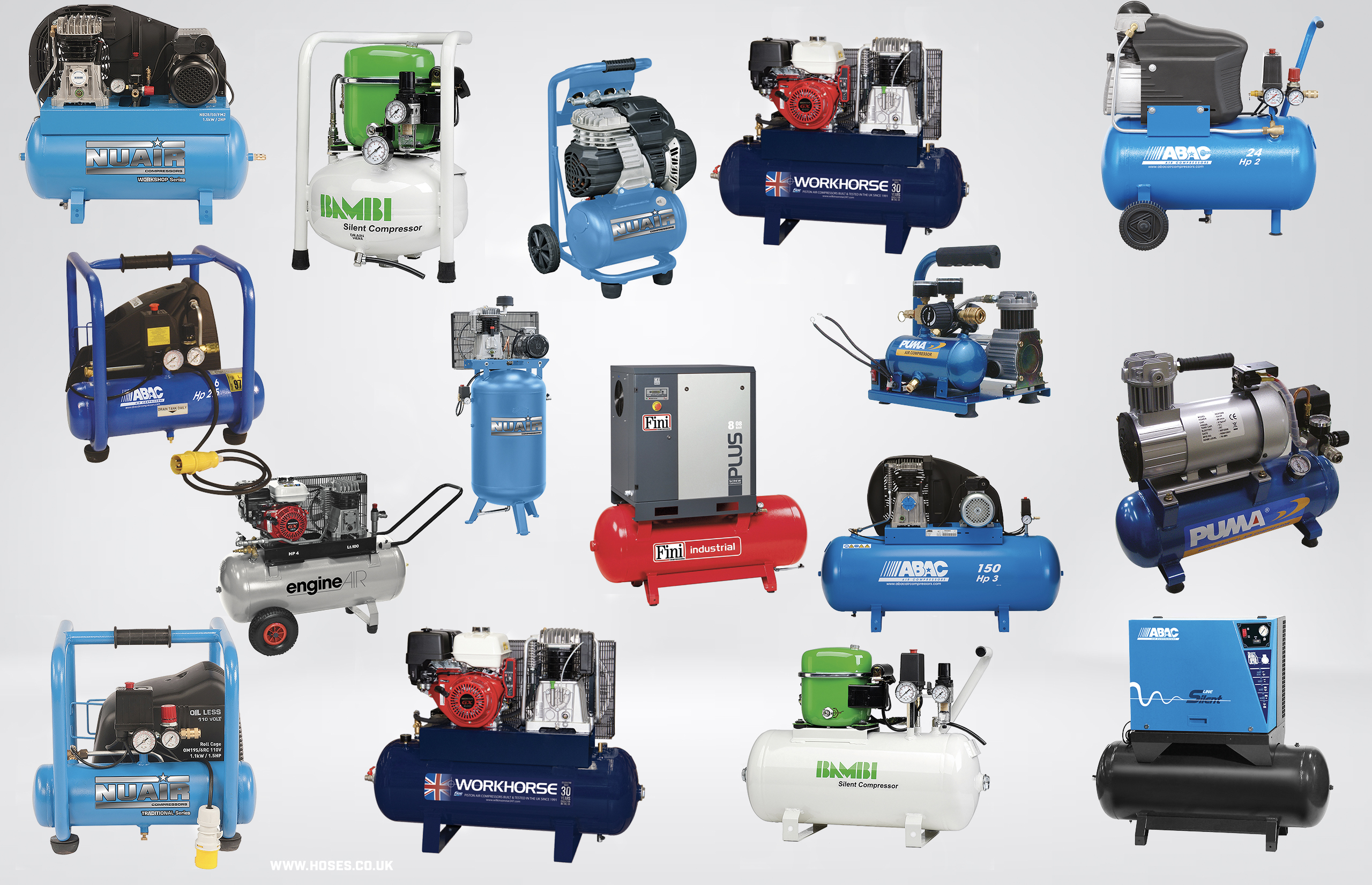
Choosing the right air compressor starts with understanding what the machine is expected to do and how it will be used in real-world conditions. From small workshops and hobbyist garages to high-demand industrial sites, the specifications you choose will directly impact performance, cost-efficiency and operational reliability.
At Hoses Direct, we work with customers every day who need help finding a model that matches their exact requirements, and we know from experience that buying based on guesswork often leads to problems down the line.
This guide is written to help you make an informed decision, covering key types of air compressors, technical considerations and how different industries use compressed air.
Why Choosing the Right Air Compressor Matters
Selecting an air compressor isn’t simply a matter of matching size or price. The right choice ensures your tools or systems perform consistently, your energy usage remains efficient, and you avoid avoidable breakdowns or maintenance issues. A compressor that’s undersized will struggle to keep up with demand, leading to unnecessary wear and reduced lifespan. On the other hand, an oversized unit wastes energy and increases running costs without delivering any practical benefit.
From a technical standpoint, compressors must match the pressure and volume needs of the equipment they supply. Air demand should be balanced against duty cycles, tank sizes and power sources. It’s also critical to consider how often the compressor will be used, and whether it needs to run continuously, intermittently, or under specific environmental conditions.
Different Requirements for B2B vs. B2C Users
Businesses and individual users often have very different expectations when selecting an air compressor. For commercial or industrial users, reliability and performance under load are top priorities. Compressors are generally integrated into wider systems or production lines, where any interruption can lead to downtime and financial loss. These users typically require higher flow rates, larger tanks, and robust components capable of continuous use. They also factor in servicing access, energy efficiency, and compatibility with existing infrastructure.
In contrast, B2C buyers, such as DIY enthusiasts, hobbyists or one-person operations, tend to focus on cost, noise level, and ease of use. Most only require intermittent operation, often for short bursts of activity like inflating tyres, powering nail guns, or using small spray equipment. Portability and low maintenance are often more important to them than extended duty cycles or system integration.
Types of Air Compressors Explained
Air compressors come in a range of designs, each suited to different applications, working environments and user priorities. The internal mechanism used to compress air has a significant effect on performance, maintenance needs, and overall efficiency. Understanding how each type functions helps ensure you select the right model for your intended use, whether that’s light domestic tasks or continuous industrial output.
We’ll start with reciprocating piston compressors, a common choice across both domestic and commercial settings.
Reciprocating (Piston) Compressors
Reciprocating air compressors use a piston driven by a crankshaft to draw in air, compress it, and deliver it to a storage tank. They are well-suited to low-to-medium demand applications and are widely used in workshops, garages, and small manufacturing setups. These compressors are typically available in single-stage and two-stage formats, with two-stage models capable of delivering higher pressures for more demanding tasks.
One of the main advantages of piston compressors is their straightforward design, which makes them cost-effective and relatively easy to maintain. However, they are best suited to intermittent use, as continuous operation can lead to overheating and excessive wear.
Rotary Screw vs. Scroll Compressors
Rotary screw and scroll compressors are both designed for continuous operation, but they function in very different ways. Rotary screw compressors use two interlocking helical rotors to compress air, making them ideal for high-demand industrial settings where air supply needs to be steady and uninterrupted. They are efficient, quiet compared to piston models, and well-suited for long-duty cycles without significant wear.
Scroll compressors operate by using two spiral-shaped elements—one fixed and one orbiting—to compress air smoothly and quietly. They are compact and often used in environments where space is limited and noise needs to be minimised. Although scroll compressors are generally more expensive and limited in output compared to screw models, they offer excellent reliability in clean, dry applications with moderate air demands.
Oil-Free Air Compressor Benefits & Use Cases
Oil-free air compressors are designed to deliver clean, dry air without the need for internal lubrication. This makes them essential in environments where air purity is critical, such as food production, pharmaceuticals, electronics, and laboratories. The absence of oil reduces the risk of contamination, simplifies maintenance, and eliminates the need for oil separation or filtration systems downstream.
From an engineering perspective, these compressors often rely on specialised coatings or materials to reduce friction within the compression chamber. While they tend to have a shorter service life and higher initial cost than lubricated models, the reduced maintenance and compliance benefits often outweigh these factors in the right setting.
Quiet/Low Noise Air Compressor Options
Low noise air compressors are engineered to reduce sound levels during operation, making them suitable for use in enclosed spaces, residential areas, or noise-sensitive work environments. These models often incorporate sound-insulated casings, anti-vibration mounts and slower-running motors to minimise mechanical and acoustic output.
At Hoses Direct, we frequently supply these units to workshops, dental practices, mobile repair services and small-scale production setups where noise restrictions are a concern. While they may not deliver the same airflow as larger industrial units, the trade-off in sound reduction can be a major benefit, especially where health and safety or comfort are a priority.
With compressor types now covered, the next section focuses on how different industries use compressed air, highlighting the key features that matter in each case.
Feature Highlights for Specific Industries
Different industries rely on air compressors in unique ways, often under very specific operating conditions. Understanding which features matter most in each sector helps ensure that the right equipment is selected the first time, reducing the risk of downtime, over-specification or underperformance. Some sectors require constant airflow under harsh conditions, while others prioritise cleanliness, portability or low noise.
For Agricultural & Transportation Needs
In agriculture and transportation, air compressors are often expected to perform in demanding, sometimes remote environments. On farms, they power tools, inflate tyres, and run automated systems such as feed and irrigation controls. In transport and fleet management, compressors are used for air brake systems, tyre inflation, and maintenance tools. These settings typically require durable, mobile units with the capacity to deliver consistent air under varying loads.
What matters most in these sectors is reliability and portability. Many agricultural users benefit from petrol or diesel-driven compressors that can operate without mains power. In transport depots, stationary electric models are common, often housed in workshops where multiple tools run from a central air source.
For Construction, Plant & Utilities
In construction, plant, and utility sectors, air compressors must withstand heavy-duty use, harsh environments, and irregular operating schedules. These industries often rely on compressors to power breakers, drills, compactors, and lifting equipment. Equipment is frequently moved between sites, so rugged build quality and reliable starting, regardless of conditions, are essential.
We frequently supply static and towable units to these sectors, depending on site access and required output. Compressors in this category are usually specified with high flow rates, fast recovery times, and large air receivers to handle fluctuating demands. Safety is another factor, especially on utility sites where compressed air is used near sensitive infrastructure or confined spaces.
For Prototype Makers & Hobbyists
Prototype makers and hobbyists often work in personal workshops or small studios, where space, noise, and power availability are limited. Their air compressor needs are typically modest in terms of output, but they still require dependable performance for tasks such as airbrushing, light tool use, and small-scale assembly. Consistency is key, especially for detailed or delicate work where pressure fluctuations can affect results.
These users benefit most from compact, oil-free, and low-noise models that are easy to move and maintain. We regularly advise hobbyists to focus on CFM ratings that match their most demanding tool and to avoid overspending on capacity they don’t need. For prototype developers, clean air and controllable output are often the deciding factors, particularly when working on electronics or sensitive components.
How Hoses Direct Can Help
Selecting the right air compressor can be challenging without expert guidance, especially when technical demands vary across industries and working environments. At Hoses Direct, we support both trade professionals and individuals by offering informed, practical advice backed by real-world application knowledge. Whether you need a mobile unit for site use or a fixed system for a production line, we help identify the right solution based on usage, budget, and operational needs.
As a supplier with a wide range of models, components, and accessories, we ensure compatibility between your compressor and the equipment it powers. We also understand the specific requirements of sectors like manufacturing, utilities, agriculture, and automotive, and advise accordingly.
Order & Enquiry Process (Phone & Online)
At Hoses Direct, customers can order air compressors and accessories directly through our website or speak to a member of our technical team by phone. Most individuals choose to browse and buy online, where full product specifications, pricing, and availability are listed.
For business customers with specific requirements or larger orders, we recommend calling us directly so we can offer tailored advice and ensure you’re selecting the most suitable system for your operation.
We regularly assist with product selection, compatibility checks, and sourcing alternatives if a particular model is unavailable. For repeat buyers or those looking to establish ongoing supply arrangements, we can also discuss bespoke solutions and volume pricing.
Summary
Choosing the right air compressor depends on understanding your specific application, the demands placed on the equipment, and how different models perform under real operating conditions. From compact oil-free units for hobbyists to high-output rotary screw systems for industry, each compressor type offers distinct benefits. Factoring in technical requirements like CFM, duty cycle, noise levels and maintenance will help avoid costly missteps and ensure a reliable supply of compressed air.
At Hoses Direct, we combine technical knowledge with a broad product range to support both individuals and businesses across the UK. Whether you’re sourcing a new compressor for your workshop or upgrading an existing setup for industrial use, our team is here to guide you through the process.
To speak with one of our experts or place an order, visit www.hoses.co.uk or call us directly. We’re ready to help you find the right air compressor, built for your job, your budget and your expectations.