


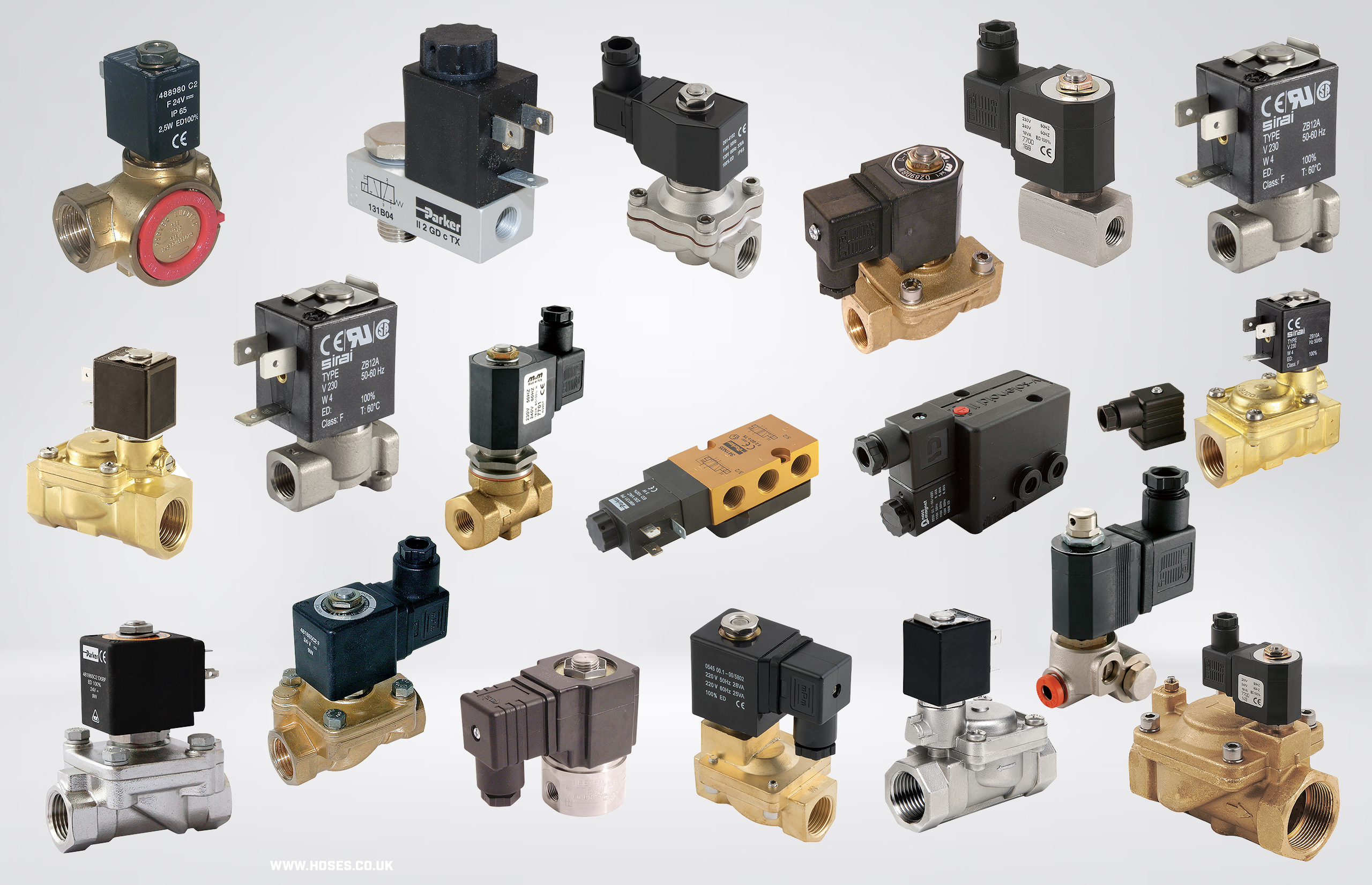
Solenoid valve types vary significantly depending on their internal construction, actuation method, flow paths, and application. Understanding the distinctions between these types is essential when specifying components for fluid or gas control systems. Whether you’re working in agriculture, manufacturing, or process automation, choosing the right solenoid valve ensures safe, efficient, and reliable operation.
At Hoses Direct, we supply a broad range of solenoid valves to suit different pressures, media types, voltages, and environments. This guide will explain the various types available, how they work, and how to select the right one for your application.
What Is a Solenoid Valve?
A solenoid valve is an electromechanically operated valve used to control the flow of liquids or gases. It opens or closes when an electrical current passes through a solenoid coil, creating a magnetic field that moves an internal plunger or diaphragm. This motion either allows or blocks flow through the valve body. The design makes solenoid valves ideal for remote, rapid, or automated switching in both simple and complex systems.
These valves are valued for their compact size, reliability, and fast response time. They are commonly used where precision control is required, or where manual operation is not feasible. Available in a variety of configurations, they can be specified based on voltage, body material, flow path, and actuation type.
Basic Components and Operation
A solenoid valve consists of a coil, a core or plunger, a spring, a valve seat, and the valve body. When energised, the coil generates a magnetic field that lifts the plunger away from the seat, allowing media to flow. When the power is removed, the spring returns the plunger to its original position, stopping the flow. This basic mechanism can vary slightly depending on the valve type, but the core principle remains the same.
The response time and durability of the valve depend on the quality of its internal components, particularly the coil and seals. Some designs rely on pressure differentials to operate, while others are independent of system pressure.
Common Applications
Solenoid valves are used across a wide range of industries to control the flow of air, water, oil, steam, and other fluids. In agriculture, they regulate irrigation systems. In manufacturing, they’re integrated into pneumatic and hydraulic systems for automation. In transportation and plant equipment, they are often fitted into fuel and coolant lines. They’re also widely used in HVAC systems, food processing, water treatment, and laboratory equipment where precision and reliability are essential.
What makes them so adaptable is their ability to provide quick and automated control without manual intervention. This allows engineers and technicians to streamline system design and reduce maintenance requirements. Depending on the valve type, they can handle anything from low-pressure water lines to high-pressure hydraulic circuits.
Classification by Actuation Mechanism (Working Principle)
Solenoid valves are categorised by how they operate internally in response to an electrical signal. The actuation mechanism directly affects how the valve opens and closes, its response time, and the pressure range it can handle. Some valves use direct mechanical movement to shift the seal, while others rely on line pressure to assist operation. Understanding these differences is essential when selecting a valve for systems with varying flow requirements, pressure levels, or media types.
Each actuation method has strengths suited to specific tasks, from simple on/off control to more precise modulation of flow. At Hoses Direct, we guide customers through these options to ensure compatibility with their existing equipment and operational needs.
Direct-Acting Solenoid Valve
A direct-acting solenoid valve operates without the need for system pressure to assist in opening or closing the valve. When the coil is energised, the magnetic field moves the plunger directly against the seat, allowing flow through the valve. This makes it suitable for low-pressure applications or where there is no pressure differential across the valve.
Because the valve’s function is purely mechanical and independent of line pressure, it offers reliable operation even in systems with slow flow or inconsistent pressure. These valves tend to have a relatively simple internal structure and are commonly used in small bore, precise applications such as dosing, vacuum systems, and low-pressure gas or liquid control.
Pilot Operated (Indirect) Solenoid Valve
A pilot operated solenoid valve relies on the system’s pressure differential to open and close. When the solenoid coil is energised, it opens a small pilot orifice that releases pressure from the main diaphragm or piston. The resulting imbalance allows the main valve to open, enabling flow. Once de-energised, the pressure equalises, and the valve closes.
This type of valve is ideal for applications with consistent pressure and larger flow requirements. It is commonly found in water, oil, and compressed air systems where energy efficiency and compact design are important. Because the solenoid only needs to operate a small pilot mechanism, these valves require less power to function compared to direct-acting types.
Proportional Solenoid Valve
Proportional solenoid valves provide variable control over flow or pressure by adjusting the position of the plunger in response to an analogue input signal. Unlike traditional solenoid valves that operate in a fully open or fully closed position, these valves modulate flow based on the level of current supplied to the coil. This allows for more accurate regulation in systems requiring fine control.
They are commonly used in advanced process automation, chemical dosing, and control loops where precise adjustment is essential. Proportional valves help reduce energy use and wear by eliminating the need for constant cycling between open and closed positions. Their performance depends on accurate signal control and stable system conditions.
Classification by Flow Paths (“Ways”)
Solenoid valves are also classified by the number of ports and flow paths they control, referred to as “ways.” This determines how the valve directs the media and whether it simply opens or closes flow, or redirects it between different outputs. The choice of flow path configuration depends on the specific control requirement within a system.
Understanding the function of each valve type is essential for specifying the correct component. Whether isolating flow, diverting it, or alternating between circuits, each configuration serves a distinct purpose in fluid or gas handling systems.
2 Way Solenoid Valve (on/off control)
A 2 way solenoid valve has one inlet and one outlet, allowing it to either permit or block flow. It is used for simple on/off control in systems where media needs to be started or stopped entirely. When the coil is energised, the valve opens; when de-energised, it closes, or vice versa, depending on whether it is a normally open or normally closed design.
These valves are widely used in water supply lines, compressed air systems, fuel delivery, and chemical transfer. Their compact design and straightforward function make them suitable for both industrial and commercial applications where dependable shut-off is required.
3 Way Solenoid Valve (supply/exhaust switching)
A 3 way solenoid valve features three ports and is designed to alternate flow between two different pathways. Depending on its configuration, it can either direct an input to one of two outputs or divert flow from one input to two outputs. These valves are commonly used for controlling actuators, cylinders, or pneumatic devices where a supply and exhaust function is needed.
When energised or de-energised, the internal mechanism shifts position to reroute flow accordingly. This allows for more complex control schemes, such as switching between pressure and venting in pneumatic systems or managing direction in low-pressure fluid control.
5 Way Solenoid Valve (multi-port diversion)
A 5 way solenoid valve has four ports and is used to control the movement of double-acting actuators or cylinders. It allows for full control of forward and reverse motion by directing pressure to one side of the actuator while exhausting the opposite side. When the solenoid is activated, the valve switches the pressure and exhaust paths, reversing the actuator’s direction.
These valves are common in industrial automation, machinery, and pneumatic systems where precise directional control is required. They are particularly useful in equipment that demands repeatable motion under changing load conditions.
Normally Open vs Normally Closed Solenoid Valves
Solenoid valves are typically defined by their default state when not energised, either normally open or normally closed. This distinction affects how the valve behaves in the event of a power failure and determines its suitability for specific control tasks.
A normally closed solenoid valve remains shut when de-energised, preventing any flow through the system. When electrical power is applied to the coil, the valve opens to allow media to pass. This default state makes it the preferred choice for applications where flow must be stopped in the event of a power failure, such as safety systems or fluid isolation.
These valves are commonly used in fuel lines, compressed air control, and water supply systems where controlled activation is required. Their design ensures that the system remains in a secure state when idle, helping to prevent leaks, spills, or unintended activation.
A normally open solenoid valve allows media to flow when no electrical power is applied. Once the coil is energised, the valve closes and stops the flow. This configuration is suited to systems that require continuous flow by default and only stop when an active signal is sent.
These valves are often used in applications such as cooling circuits, purge lines, and some heating systems where maintaining flow during idle conditions is necessary. Their use can also reduce energy consumption in systems where the valve spends most of its time in the open state.
Materials, Seals & Voltage Options
Selecting the right solenoid valve involves more than just flow capacity or actuation type. The materials used in the valve body, internal seals, and the electrical coil must all match the demands of the media and environment. Corrosion resistance, pressure rating and temperature tolerance are key factors when specifying components for long-term reliability.
At Hoses Direct, we supply solenoid valves in a wide range of materials and configurations to meet the varied needs of industrial and commercial applications. Understanding how these options affect performance ensures that the valve functions safely and efficiently under operating conditions.
Common Body Materials: Brass, Stainless Steel, Plastic
Brass is one of the most commonly used materials for solenoid valve bodies due to its balance of strength, corrosion resistance, and cost. It’s suitable for general-purpose use with water, air, light oils, and non-aggressive fluids. For harsher environments or chemically aggressive media, stainless steel offers superior corrosion resistance and mechanical durability, making it ideal for food processing, marine, and chemical applications.
Plastic-bodied solenoid valves are typically used in lightweight or cost-sensitive installations where corrosion is a concern, such as in water treatment or laboratory systems. Although not as robust under pressure as metal-bodied valves, plastics can offer good chemical compatibility and are resistant to scale and sediment.
Seal and Diaphragm Options: NBR, EPDM, PTFE
The choice of seal and diaphragm material directly affects a solenoid valve’s compatibility with different media and its ability to withstand varying temperatures and pressures. Nitrile rubber (NBR) is widely used for general-purpose applications involving air, water, and light oils. It offers good wear resistance but is not suitable for strong chemicals or high temperatures.
EPDM provides improved chemical resistance, especially against water-based fluids, steam, and some mild acids. It’s a common choice in HVAC and water treatment systems. PTFE is chemically inert and resistant to extreme temperatures, making it suitable for aggressive fluids, solvents, and demanding process environments.
Why Buy Solenoid Valves from Hoses Direct?
At Hoses Direct, we supply solenoid valves to meet the demands of both industrial and commercial users across the UK. Our focus is on providing quality components with fast delivery, backed by a technical support team that understands the practical challenges faced by customers. Whether the requirement is for a standard valve or a specific configuration to suit a custom installation, we work closely with customers to recommend the right solution from the outset.
We understand the importance of reliability, compliance, and compatibility, especially when dealing with time-critical or safety-sensitive systems. By offering a wide product range and clear technical guidance, we help ensure our customers get components that perform as expected and integrate easily into their systems.
Technical Support & B2B / OEM Services
At Hoses Direct, we work directly with OEMs, contractors, and maintenance teams to supply solenoid valves that meet precise technical and operational requirements. Our in-house support team offers guidance on product selection, helping customers navigate specifications such as pressure ratings, media compatibility, and electrical requirements. We also assist with cross-referencing older or discontinued models to ensure continuity in long-term projects.
For repeat B2B orders, we provide a reliable supply chain with fast lead times and competitive pricing. Our technical advice extends beyond sales, with ongoing support available via phone or email to troubleshoot issues or recommend suitable replacements.
Summary
Solenoid valves play a vital role in controlling fluid and gas across a wide range of industries. From actuation methods to flow configurations, material choices, and voltage options, each aspect of valve selection influences performance, safety, and reliability. Understanding these technical differences is essential to making the right choice for your system.
At Hoses Direct, we supply solenoid valves to suit everything from straightforward shut-off control to complex, multi-line flow systems. Whether you’re an individual sourcing a replacement or a business seeking reliable, long-term supply for industrial use, we offer both the range and the technical expertise to support your needs.
For advice on selecting the right solenoid valve or to place an order, speak with our team today.