


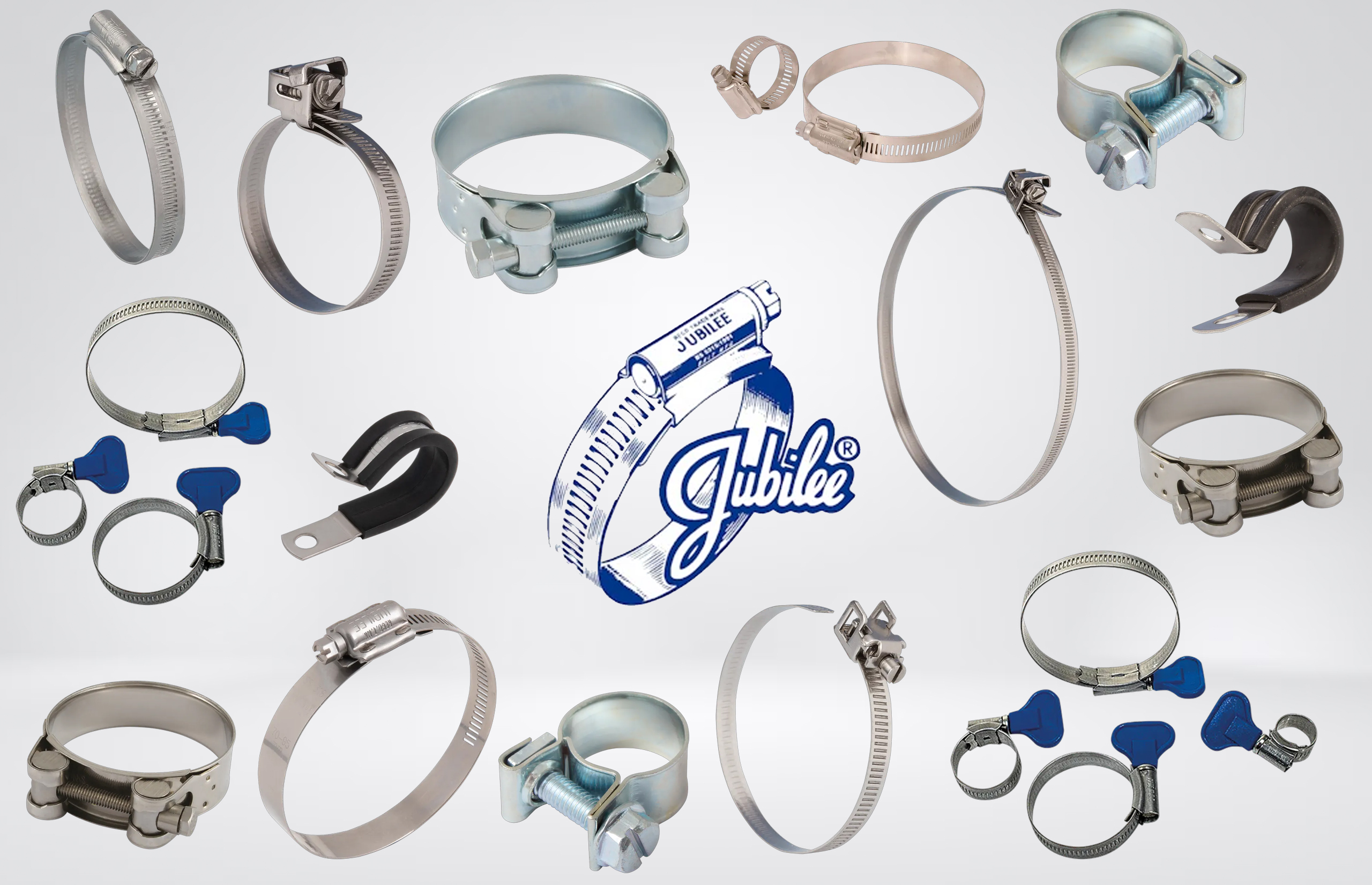
A hose assembly is only as reliable as the connection holding it together. You can specify the correct hose, choose a well-machined hose tail and install everything carefully, but if the jubilee clip isn’t suited to the application, the assembly can still develop leaks, allow the hose to creep along the fitting or fail long before the hose reaches the end of its expected service life.
At Hoses Direct, we regularly help customers investigate recurring hose problems that initially appear to be caused by a poor-quality hose. Quite often, the hose itself isn’t the issue. The real cause is an incorrectly sized clip, unsuitable clamp material, poor installation or operating conditions placing greater demands on the connection than the original specification allowed for.
The most reliable hose assemblies are specified as complete systems, with the hose, fitting and clamp all suited to the operating conditions rather than selected independently. That’s why a component that costs only a few pounds can have such a significant influence on maintenance costs, equipment reliability and service life.
What Actually Causes Hose Leaks Around a Jubilee Clip?
When a hose starts leaking around the connection, it’s tempting to assume the clip hasn’t been tightened enough. In reality, that’s only one of several possible causes, and it’s rarely the most common. Persistent leaks are more often traced back to an issue with the specification or installation of the complete connection than the clamp itself.
The first thing to check is whether the clip is actually the correct size for the installed hose. A jubilee clip should be working comfortably within its adjustment range once the hose is fully seated on the fitting. If it’s almost fully tightened before the connection feels secure, there is very little adjustment left to accommodate normal hose relaxation. If it’s oversized, the band may not apply uniform pressure around the full circumference, leaving areas where the seal is weaker.
The condition of the hose is equally important. Rubber naturally hardens as it ages, while some PVC and thermoplastic hoses can lose flexibility after prolonged exposure to heat, UV light or certain chemicals. Once the hose material can no longer compress properly around the fitting, tightening the clip further usually achieves very little. In many cases, replacing the hose is the only reliable solution.
The fitting itself is another common source of trouble. Worn serrations, corrosion, scratches or damage caused during previous maintenance can all prevent the hose from sealing properly. A new clip fitted to a damaged hose tail often produces exactly the same leak because the sealing surface has already been compromised.
Installation also plays a significant role. If the hose hasn’t been pushed fully onto the fitting, the clip may be clamping unsupported hose rather than the section reinforced by the hose tail. Likewise, if the hose has been twisted during installation or is under constant tension, the connection is continually being pulled away from its natural position. The clip isn’t designed to correct those installation problems, so they often reappear as leaks later.
Perhaps the biggest misconception is that more tightening will always improve the seal. Beyond a certain point, additional clamping force simply compresses the hose further, increasing the risk of deformation or damage without addressing the underlying cause. If a connection repeatedly requires tightening, it’s usually telling you that something else in the assembly needs attention.
Taking a few minutes to inspect the hose, fitting and installation method before replacing components often leads to a faster and more permanent solution. In many cases, the leak isn’t caused by the jubilee clip at all, it’s simply where the effects of a wider specification or installation issue become visible.
Choosing the Correct Jubilee Clip Size
Selecting the correct jubilee clip starts with one simple principle: choose a clip to suit the installed hose diameter, not the hose’s nominal bore.
This catches people out more often than you might expect. Two hoses with the same internal diameter can have completely different wall thicknesses, particularly if one is a lightweight PVC hose and the other is a heavy-duty reinforced rubber hose. Once fitted onto the hose tail, their outside diameters can differ considerably, meaning they’ll require different clamp sizes despite carrying the same fluid.
A jubilee clip should ideally operate around the middle of its adjustment range once the connection has been assembled. This allows enough travel to apply the required clamping force while leaving capacity to accommodate normal changes in the hose over its service life. Rubber hoses can relax slightly after installation, while temperature changes and material ageing may alter the outside diameter over time.
Choosing an oversized clip often leads to uneven clamping. Because the band has further to tighten before it begins applying significant pressure, the load may not be distributed consistently around the hose. On softer hose materials, this can create areas where the seal is weaker, increasing the likelihood of small leaks developing.
Undersized clips create different problems. The adjustment mechanism may already be close to its limit before the correct clamping force has been achieved, placing unnecessary stress on the screw housing and threads. The result can be stripped threads, damaged bands or a connection that never quite feels secure despite being tightened as far as it will go.
It’s also worth remembering that not all hoses compress by the same amount. Softer silicone and PVC hoses deform more readily than reinforced industrial rubber hose, while wire-reinforced suction hoses offer considerably more resistance to compression. The aim isn’t to squeeze every hose as tightly as possible, but to apply enough even pressure to create a reliable seal without damaging the hose structure.
When replacing an existing clip, avoid assuming the original specification was correct. Many hose assemblies have been repaired several times during their working life, often using whatever clamp happened to be available. Measuring the outside diameter of the installed hose and reviewing the operating conditions usually takes only a few minutes, but it can prevent repeated maintenance and improve the long-term reliability of the connection.
A correctly sized jubilee clip doesn’t just make installation easier. It provides more consistent clamping force, helps maintain a reliable seal as the hose ages and reduces the likelihood of the connection needing attention long before the hose itself requires replacement.
Selecting Jubilee Clips for Long-Term Reliability
A jubilee clip is often one of the smallest and least expensive components in a hose assembly, but its influence on long-term reliability is out of proportion to its size. A correctly specified clamp helps maintain an effective seal despite pressure changes, vibration and normal ageing, while an unsuitable one can become the starting point for recurring leaks, hose movement and premature component replacement.
Choosing the right clip involves more than matching the diameter of the hose. The operating pressure, hose material, temperature range, surrounding environment and expected duty cycle all influence how the connection will perform over time. Two hoses of exactly the same size may require different clamping solutions because the demands placed on the assembly are completely different.
Before specifying or replacing a jubilee clip, it’s worth considering the complete operating conditions:
- The installed outside diameter of the hose.
- Operating pressure and any pressure fluctuations.
- Hose material and construction.
- Operating temperature.
- The media being conveyed.
- Exposure to moisture, chemicals or corrosive environments.
- Vibration and mechanical loading.
- Hose routing and support.
- Access for future inspection and maintenance.
Reviewing these factors at the outset often prevents the recurring problems that develop when a clamp is selected on size alone.
It’s equally important to think about the cost of the connection over its entire service life rather than simply the purchase price of the clip. A clamp that performs reliably for years, reduces maintenance visits and prevents unexpected downtime almost always represents better value than repeatedly replacing low-cost components that were never suited to the application.
At Hoses Direct, our technical team approaches hose assemblies as complete engineered systems rather than individual parts. When customers experience repeated leaks or premature hose failures, the solution is rarely just a different clip. More often, it’s identifying how the hose, fitting, clamp and operating conditions interact, then specifying components that are properly matched to the application.
The best hose connections are usually the ones that never attract attention. They remain secure through years of pressure cycling, vibration and everyday use because the correct components were selected from the beginning. Spending a little longer assessing the application before choosing a jubilee clip is often enough to avoid repeated maintenance, extend hose life and improve the reliability of the entire assembly.
If you’re struggling with constant small leaks, then speak with the expert team today, and we’ll review your existing conditions and ensure you have the right clip for your application.
Email: [email protected]
Phone: 0333 6000 501