


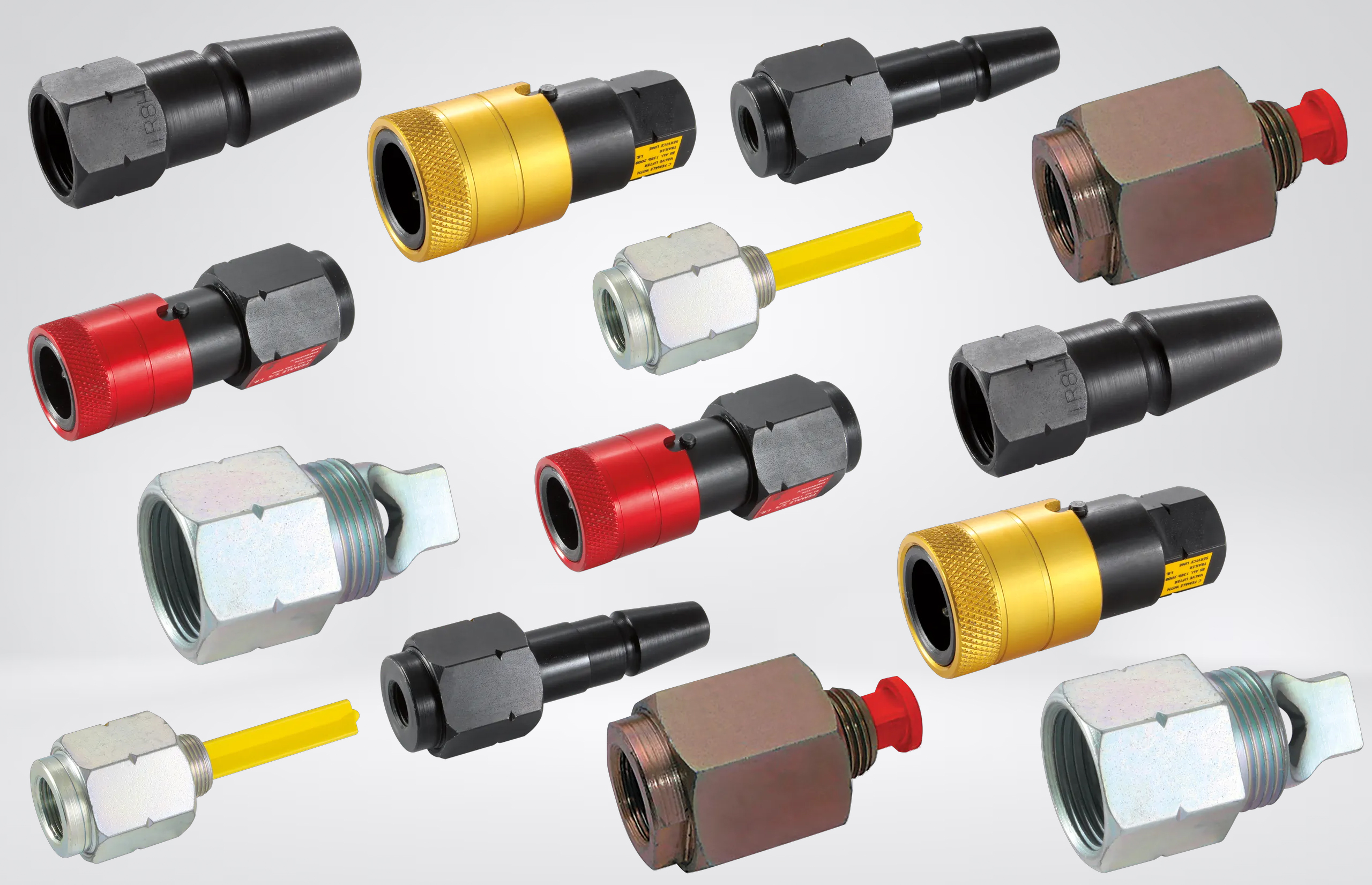
Quick release couplings make compressed air systems easier to work with, particularly where hoses, pneumatic tools and equipment need to be changed regularly. The important difference between coupling designs becomes apparent when that connection is released.
With a conventional quick release coupling, disconnecting the plug normally shuts off the upstream air supply. However, compressed air can remain trapped in the hose or equipment downstream of the coupling. When the plug is released, that stored air expands to the atmosphere and, if enough pressure and volume are involved, can cause the hose end to move suddenly.
Air break couplings, often referred to as safety couplings, are designed to control this part of the disconnection process. Rather than releasing a pressurised plug immediately, they allow downstream pressure to exhaust while the connection is still retained. Once that pressure has reduced, the plug can be removed with considerably less pneumatic force acting on the hose.
That does not make an air break coupling the correct choice for every connection. A fixed pneumatic line that is only disconnected during planned maintenance has very different requirements from a workshop hose where operators change air tools throughout the day. Flow demand, hose size, stored air volume, plug compatibility and the way the system is isolated all influence the specification.
The useful comparison is therefore not simply whether an air break coupling is “safer” than a standard quick release coupling. The question is whether controlled depressurisation solves a genuine problem in the way that particular compressed air connection is used.
What Happens When a Standard Quick Release Coupling Is Disconnected?
Most standard quick release couplings contain a shut-off valve that closes as the plug is removed. This stops the upstream air supply, but it does not necessarily remove the compressed air already contained in the hose, tool or pneumatic circuit downstream.
Consider a workshop hose supplied at 7 bar. Once the coupling valve closes, the compressor side is isolated, but the hose itself can still be charged. Releasing the plug gives that trapped air a route to atmosphere. The resulting reaction force can cause the free end of the hose, together with the plug and hose tail, to move suddenly.
How aggressively it moves depends on more than system pressure. Hose bore and length determine how much compressed air is stored downstream, so a short small-bore tool connection can behave very differently from a long, larger-bore workshop hose operating at the same pressure. Hose flexibility, routing and the equipment attached downstream will influence the result as well.
This distinction is particularly important when assessing an existing installation. A pressure gauge showing 7 bar does not tell you how much stored pneumatic energy will be released when the connection is opened. You also need to consider the downstream volume and whether that pressure has another route to exhaust before the plug separates.
Where a connection is rarely disturbed and the circuit is deliberately depressurised before maintenance, this may present little practical difficulty. Where operators repeatedly disconnect a charged hose throughout the working day, the behaviour of the coupling during release becomes a much more important part of its specification.
How Does an Air Break Coupling Work Differently?
An air break coupling changes the order in which the connection is released. Instead of allowing the plug to separate while downstream pressure is still acting on it, the coupling retains the plug while the supply is isolated and the trapped air is exhausted.
In practical terms, the sequence becomes:
isolate the supply → exhaust downstream pressure → release the plug
Different coupling designs achieve this in different ways. Some use a two-stage sleeve movement, while others use a push-button or similar controlled-release mechanism. The operating method matters when choosing a particular product, but the engineering principle is the same: the hose should lose its stored pressure before its end is free to move.
The amount of air downstream determines how quickly this happens. A short connection to a pneumatic tool may depressurise almost immediately, whereas a long, larger-bore hose contains substantially more air and can take longer to exhaust. Operators should allow the coupling to complete that process rather than trying to force the plug through the release sequence.
It is also important to understand what the coupling does not do. An air break coupling only manages the pressure trapped downstream of that connection. It does not depressurise the complete compressed air installation or replace the need for proper isolation and exhaust arrangements when machinery is being maintained.
Its value is much more specific: it provides a controlled way of dealing with residual pressure at a connection that needs to be disconnected.
Air Break Coupling vs Standard Quick Release Coupling: The Practical Differences
Both coupling types provide a quick way to connect and disconnect pneumatic hoses and equipment. The main difference is what happens to the compressed air trapped downstream when the connection is released.
| Consideration | Standard Quick Release Coupling | Air Break Coupling |
| Quick connection and disconnection | Yes | Yes |
| Upstream supply shut off on disconnection | Typically | Typically |
| Controlled downstream depressurisation | Not necessarily | Yes |
| Plug retained while trapped pressure exhausts | Generally no | Yes, according to coupling design |
| Risk of hose movement during charged disconnection | Can be significant depending on pressure and downstream volume | Reduced by exhausting pressure before release |
| Operation | Usually single-stage release | Typically staged or controlled release |
| Initial cost | Generally lower | Generally higher |
| Typical application | Controlled or infrequently disconnected connections | Frequently disconnected hoses and pneumatic tools |
For buyers, the higher purchase price of an air break coupling is an obvious difference, but cost should only be compared once the duty of the connection has been established. On a workshop hose that is disconnected repeatedly while charged, controlled depressurisation addresses a genuine operating issue. On a fixed machine connection opened only after the pneumatic circuit has been isolated and exhausted, the additional mechanism may provide relatively little benefit.
Flow performance also needs to be considered. Couplings that share the same nominal thread size can have different internal bores and flow characteristics. An air break coupling that controls disconnection well but restricts the airflow required by a high-consumption pneumatic tool is not correctly specified for that application.
The comparison therefore comes down to more than the release mechanism. The coupling still has to provide the required pressure and flow performance, match the existing plug system and suit how frequently the connection is operated.
Can an Air Break Coupling Replace an Existing Quick Release Coupling?
In many installations it can, but an air break coupling should not automatically be treated as a like-for-like replacement. The existing connection needs to be identified properly before a new socket is ordered.
Plug profile is usually the first thing to establish. Pneumatic plugs from different coupling systems can look extremely similar while using different nose dimensions, locking grooves and sealing surfaces. A plug that physically enters a coupling is not necessarily compatible with it.
Thread size is a separate specification. A 1/4″ BSP thread tells you how the coupling connects to the hose tail, manifold or equipment; it does not identify the plug profile and it does not guarantee sufficient airflow.
The replacement should also be checked against:
- operating pressure
- required airflow
- hose bore and length
- connection frequency
- temperature
- environmental conditions
- coupling and seal materials
- existing plugs and equipment
An upgrade is also a good opportunity to investigate whether the existing coupling was correctly sized in the first place. If pneumatic tools already struggle under load, replacing the old socket with an air break coupling of similar flow capacity could preserve an existing restriction.
On sites where several coupling systems have accumulated over time, changing individual sockets without considering the wider installation can create another compatibility problem. In these cases, moving towards a standardised coupling profile can make more sense than continuing to replace components individually.
Air Break or Standard Quick Release: Which Should You Choose?
Start with what happens when the connection is disconnected.
If operators regularly separate a hose while significant pressure remains downstream, particularly where the hose is long or large bore, an air break coupling provides a controlled way to release that stored pressure before the hose end becomes free.
If the connection remains assembled during normal operation and downstream pressure is reliably exhausted before it is opened, a conventional quick release coupling may be entirely suitable. Specifying an air break design simply because it offers an additional safety feature can add cost without addressing a meaningful risk.
Once the disconnection requirement is understood, check the normal pneumatic specification. The coupling still needs to deliver sufficient airflow, withstand the operating pressure and temperature, match the required plug profile and cope with the expected environment and connection frequency.
For existing installations, the behaviour of the current connection is useful evidence. Aggressive hose movement, persistent leakage, difficult connection, premature coupling wear or poor tool performance are all reasons to investigate rather than automatically order another like-for-like replacement.
The best coupling is therefore not necessarily the most sophisticated one. It is the coupling that provides the required flow, compatibility, durability and disconnection behaviour for the way the system actually operates.
If you’re unsure what coupling is best for your application, then get in touch with the expert team today to discuss your application, and we will help you identify the best solution for you.
Email: [email protected]
Phone: 0333 6000 501