


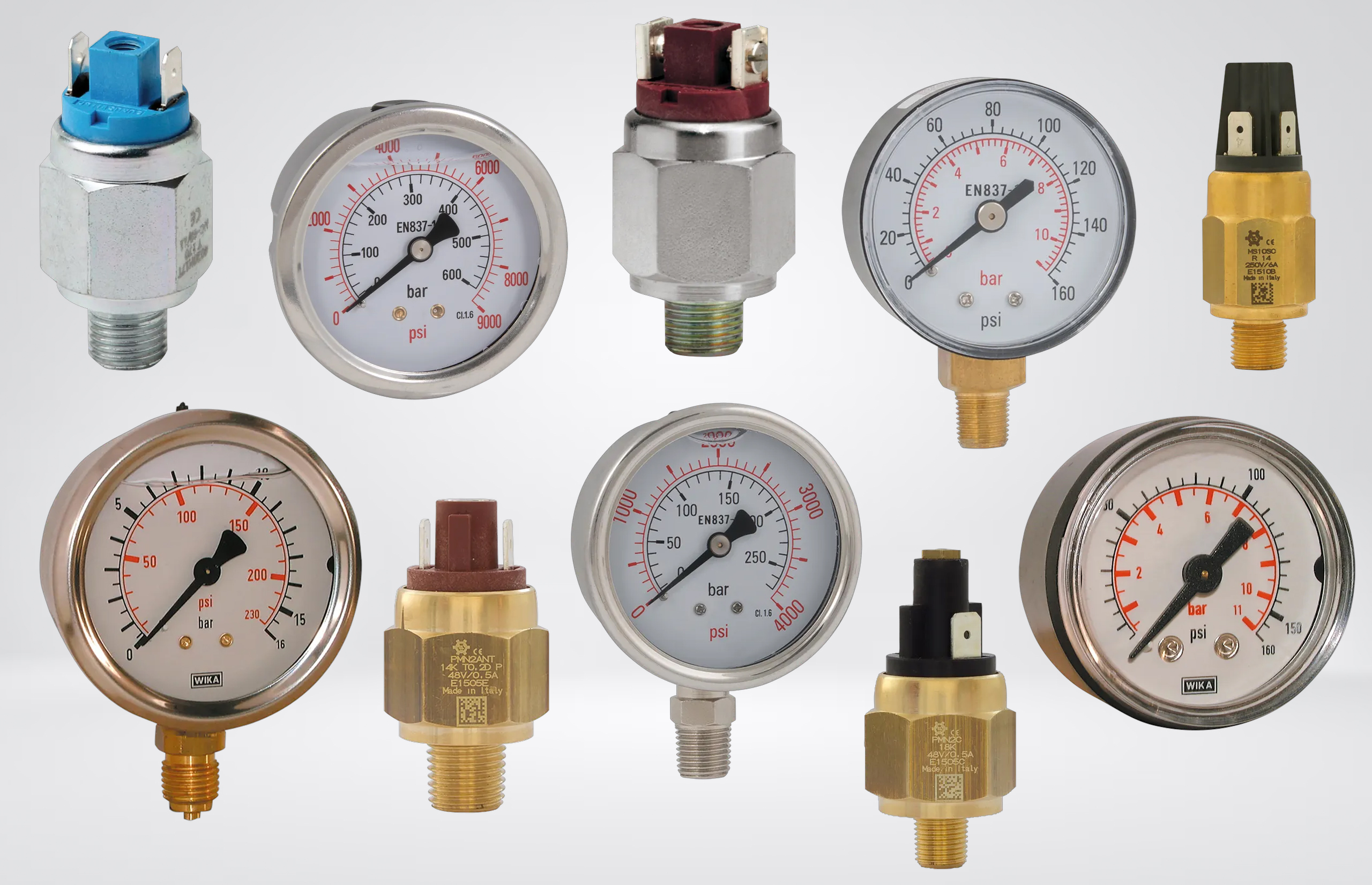
Pressure gauges and pressure switches are often installed on the same hydraulic, pneumatic and process equipment, but they perform fundamentally different jobs. A pressure gauge shows the pressure within the system. A pressure switch responds when pressure reaches a defined point and provides an electrical signal that can be used by the machine or control system.
That distinction sounds straightforward until a replacement or new installation needs specifying. A maintenance engineer investigating a hydraulic circuit may need to know whether pressure is 120 or 150 bar, in which case a switch provides limited diagnostic information. A machine that must stop automatically when pressure falls below a safe operating level needs more than a gauge for somebody to watch.
Many systems therefore use both. The gauge provides local indication for commissioning, adjustment and fault-finding, while the switch handles control, sequencing or protection.
Getting the device type right is only the beginning. Pressure range, transient pressure, pulsation, vibration, temperature, media compatibility and electrical requirements can all determine whether a gauge or switch remains reliable once installed.
What Is the Main Difference Between a Pressure Gauge and a Pressure Switch?
The easiest way to separate the two is to consider what happens to the pressure information.
A pressure gauge gives the operator or engineer a measured value. If a pneumatic supply is at 5.6 bar, the gauge allows somebody to see that value and compare it with what the machine should be receiving.
A pressure switch is concerned with a defined condition. If the machine must not operate below 5 bar, the switch can change its electrical output when that threshold is crossed, allowing the control system to prevent a cycle, generate an alarm or perform another required action.
In practical terms:
| Pressure Gauge | Pressure Switch | |
| Main purpose | Measure and indicate pressure | Detect a defined pressure condition |
| Output | Pressure reading | Electrical contact or signal |
| Shows actual pressure | Yes | Not necessarily |
| Used for automatic control | Normally no | Yes |
| Useful for fault-finding | Very | Primarily when combined with other pressure information |
This distinction is important because neither device is automatically a substitute for the other. What matters is whether the system needs pressure information, a pressure-dependent action, or both.
What Does a Pressure Gauge Actually Tell You?
A useful pressure gauge does considerably more than confirm that a system is pressurised. It helps an engineer understand how pressure changes as the equipment operates.
Consider a pneumatic machine that should receive 6 bar. If the gauge shows 6 bar while the machine is idle but falls to 4.5 bar when several cylinders operate together, simply increasing the regulator setting may not solve the problem. The pressure loss could be caused by insufficient supply capacity, undersized pipework, a restricted filter, an undersized regulator or another restriction upstream.
The same principle applies hydraulically. A gauge can help establish whether a pump is developing the expected pressure, whether a relief valve is correctly set or whether pressure changes unexpectedly as an actuator moves under load.
Where the gauge is installed matters; a healthy reading at the compressor outlet or hydraulic power unit does not prove that the same pressure is available at the point of use. Pressure losses occur across filters, regulators, valves, hoses, pipework and fittings, particularly as flow increases.
For fault-finding, comparing pressure at different points in a circuit can therefore be much more informative than looking at one conveniently positioned gauge.
The limitation is that a conventional gauge reports the condition but does not normally act upon it. If the machine needs to respond automatically to pressure, another form of pressure sensing is required.
What Does a Pressure Switch Do?
A pressure switch converts a pressure condition into an electrical response.
A hydraulic clamping circuit, for example, may need to reach a minimum pressure before machining can begin. The switch confirms electrically that this condition has been achieved. In a pneumatic system, a switch might prevent a machine cycle if the available air pressure is too low for reliable operation.
Other applications include compressor control, lubrication-pressure alarms and high- or low-pressure shutdowns.
The switch does not necessarily carry the electrical load of the equipment being controlled. It may simply provide an input to a PLC or operate a relay. Electrical contact rating, output type, and compatibility with the control system therefore need checking alongside the pressure specification.
The switching point also needs to be chosen around the machine rather than simply the normal line pressure. If equipment runs at 6 bar but becomes unreliable below 5 bar, the important figure is the minimum pressure at which reliable operation can still be guaranteed. Setting the switch unnecessarily close to normal supply pressure could create nuisance interruptions whenever ordinary demand causes a small pressure fluctuation.
This is where the behaviour of the system becomes more important than the headline pressure rating of the switch.
Can a Pressure Switch Replace a Pressure Gauge?
Sometimes, but only when there is no practical requirement to see the actual pressure.
Take a low-pressure switch set at 5 bar. Once pressure drops below its switching point, the control system knows that the condition is unacceptable. What it does not necessarily know is whether pressure has fallen to 4.9 bar or collapsed to 1 bar.
That difference can be extremely useful during fault diagnosis.
A gauge also makes routine adjustment easier. Setting a regulator, checking a hydraulic relief valve or watching pressure while an actuator operates is considerably more straightforward when the engineer has a visible pressure reading.
The reverse is also true. A conventional gauge cannot provide a reliable machine interlock simply because an operator can see that pressure is too low.
When Do You Need Both?
Using both makes sense where automatic pressure control is required but seeing the actual pressure still has operational or maintenance value.
Suppose a pressure switch on a pneumatic machine is configured to prevent operation below the minimum acceptable supply pressure. Adding a gauge allows maintenance personnel to see whether the system normally operates comfortably above that threshold or spends much of its time close to it.
That distinction can expose a developing problem before it becomes a production stoppage.
The same arrangement is useful on hydraulic equipment. If a pressure switch confirms that a clamping circuit has achieved its required pressure but starts operating inconsistently, the gauge can show whether the switch is faulty or whether the hydraulic pressure itself is fluctuating around the set point.
There is also diagnostic value in keeping indication independent of the electrical control system. A mechanical gauge remains readable without an electrical supply and provides a simple reference against which an electrical pressure signal can be checked.
That does not justify fitting both everywhere. If nobody needs local pressure indication and it adds no maintenance value, another gauge simply creates another potential leak point and component to maintain.
Choosing the Right Pressure Monitoring Solution
The most useful question when selecting pressure instrumentation is not simply, “What pressure is the system?” It is “What do we need to know or happen when that pressure changes?”
That establishes whether the application needs indication, switching or both. The operating conditions then determine the construction and specification required to make that solution reliable.
This becomes especially important when replacing a component that has failed repeatedly. A higher pressure rating or another identical replacement may not address excessive pulsation, vibration, pressure shock, incompatible materials or unsuitable switching behaviour. Finding the cause usually produces a better result than treating each failure in isolation.
Hoses Direct supplies pressure gauges, pressure switches and the associated hoses, valves and fittings used throughout hydraulic, pneumatic and industrial fluid systems. If the required specification is unclear, our technical team can help assess the pressure, media, connection and operating conditions and identify a solution appropriate for the complete application rather than simply matching the component being removed. Get in touch with the team today to discuss your requirements and application.
Email: [email protected]
Phone: 0333 6000 501