


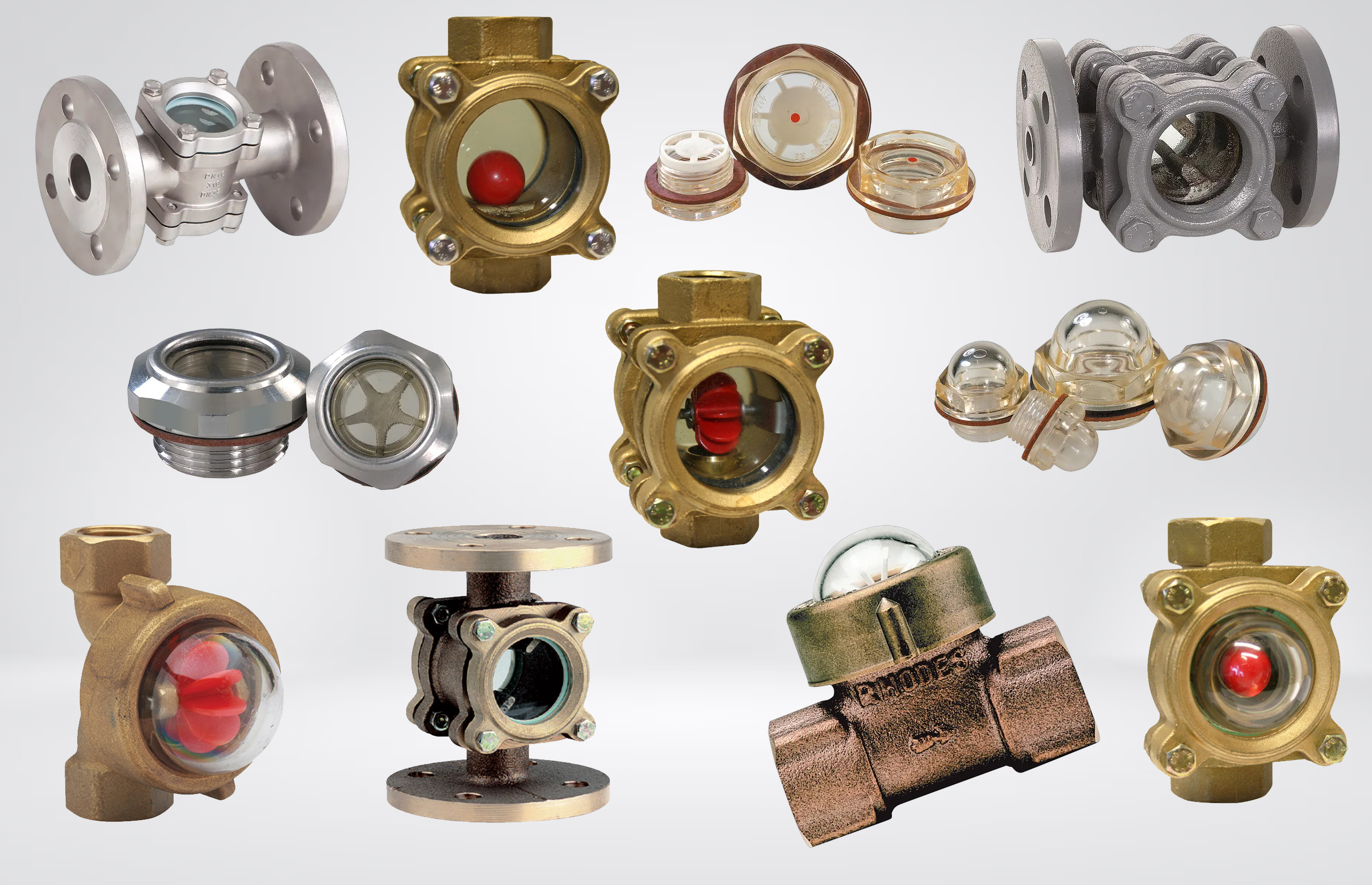
A sight glass suitable for a general water line may be completely wrong for hot lubricating oil or a concentrated process chemical. Although each product performs the same basic task, the fluid places different demands on the body, window, seals and internal indicator.
This is why “water sight glass”, “oil flow indicator” and “chemical sight glass” are only starting descriptions. Water may be chlorinated, deionised, heated or contaminated with salts. Oil could be a mineral hydraulic fluid, synthetic lubricant, fuel or heat-transfer oil. Chemical compatibility can change considerably with concentration and temperature.
Selecting the right sight glass therefore requires more than matching the nominal pipe size. The complete assembly must be compatible with the fluid and capable of handling the actual pressure, temperature, flow and cleaning conditions.
What Does a Sight Glass Show?
An inline sight glass gives operators a direct view inside the pipeline. Depending on its design and location, it can help confirm:
- Whether liquid is present or moving
- Whether an oil circuit is returning fluid to the reservoir
- When a transfer or drain line has emptied
- Changes in colour or clarity
- Entrained air, bubbles or foaming
- Suspended contamination or process deposits
A plain viewing chamber is often sufficient where movement is naturally visible or the main purpose is to inspect fluid condition. Clear liquid flowing steadily through a full pipe can appear stationary, however. A fixed vane or rotor gives operators a visual reference that makes movement easier to recognise.
A sight glass should not be confused with a flowmeter. A turning rotor confirms movement but does not normally provide an accurate flow rate. Its response is affected by viscosity, orientation, contamination and wear.
A stationary rotor does not always prove that flow has stopped either. Deposits or debris may have obstructed it while some liquid continues to pass. Where machinery protection or process safety depends on maintaining a minimum flow, use an appropriate flow switch or measuring instrument.
Why the Process Fluid Changes the Specification
Every wetted part must remain compatible with the liquid. This includes the body, window, seals, gaskets and any internal vane or rotor. A corrosion-resistant body cannot compensate for an unsuitable seal or window material.
The fluid also determines how useful the visual indication will be. Clear water can move without producing an obvious visual change. Dark oil may conceal the internal indicator, while a viscous lubricant may not move a rotor at low flow. Chemical deposits or crystallisation can obscure the window and immobilise moving parts.
Cleaning conditions are another frequent oversight. A sight glass may tolerate the normal process liquid but not the solvent, caustic wash or hot flushing fluid used during maintenance. A rapid change between hot cleaning media and a cooler process liquid can also subject the window to thermal shock.
The consequences of leakage must influence the decision. A minor seepage from a low-pressure water circuit presents a different level of risk from a release of hot oil, fuel or corrosive chemical. More hazardous duties may require confirmed material grades, conservative operating margins and carefully planned isolation.
Sight Glasses for Water
Water is not always a simple service. Its temperature, dissolved oxygen, chloride content and treatment chemicals all affect material performance. A closed cooling circuit presents different conditions from chlorinated mains water, deionised water, seawater or warm washdown water.
Cast iron PN16 sight glasses can provide an economical solution for compatible general-water and utility systems. There is little benefit in automatically upgrading to stainless steel where the water chemistry, external environment, pressure and temperature are suitable for cast iron.
Cast iron becomes less attractive where chlorides, condensation or aggressive washdown could accelerate corrosion. Internal corrosion may introduce scale into the process or reduce body thickness. External corrosion around fasteners and window retainers can also make inspection and maintenance difficult.
Bronze offers useful corrosion resistance in many compatible water applications and is available in threaded and flanged designs. The precise alloy still matters. Water chemistry can create a risk of dezincification in susceptible copper alloys, while potable-water applications may require specific approvals.
Stainless steel is often preferred where corrosion products cannot be tolerated, regular washdown is expected or cleaner external surfaces are required. It is not immune to water-related attack. Stainless grade, chloride concentration, temperature and crevices around seals all affect the risk of localised corrosion.
Scale and suspended solids can obscure the glass or restrict a rotor before the body reaches the end of its service life. If fouling is expected, the pipework should allow the unit to be safely isolated, drained and cleaned.
Sight Glasses for Oil
Sight glasses are used in hydraulic return lines, lubrication circuits, gearboxes, compressors, fuel systems and process-oil installations. The exact oil, additive package, viscosity and temperature range all influence selection.
Visibility is often the first practical challenge. Clean oil flowing slowly through a full line can appear stationary, while dark or contaminated oil may conceal movement. A vane or rotor can improve the indication, but it must respond correctly at the fluid’s operating viscosity.
Cold-start conditions are particularly important. Oil may be substantially more viscous before the system warms. A rotor can move slowly or remain stationary during start-up and then accelerate as viscosity falls, even where the volume flow changes very little. Rotor speed should not be interpreted as an informal flow measurement.
Moving indicators are also vulnerable to sludge, wear debris and varnish. A rotor may give the clearest indication in clean oil, but a plain window or fixed vane can provide more reliable long-term service where contamination is expected.
Seal selection should be based on the exact fluid. NBR is commonly compatible with many mineral oils, while FKM is used in numerous oil, fuel and elevated-temperature duties. Synthetic lubricants, fire-resistant hydraulic fluids and aggressive additives may require different materials.
Hot-oil systems need additional attention. The permitted working pressure may reduce at elevated temperatures, and repeated heating and cooling can affect gasket compression. Introducing hot oil into cold equipment, or cooling a hot sight glass too rapidly, can damage the window through thermal shock.
Deposits on the glass may also reveal a wider oil-condition problem. Repeated varnishing or darkening can indicate oxidation, overheating or contamination. Cleaning the window restores visibility but does not correct the underlying system condition.
Sight Glasses for Chemicals
“Chemical resistant” is not a complete specification. The precise substance, concentration and temperature must be known, together with any mixtures, reaction products and cleaning fluids.
Stainless steel is widely used because it offers broad corrosion resistance and performs well in many process and washdown environments. It is not suitable for every chemical. Chloride-bearing liquids can cause pitting or crevice corrosion, particularly as temperature rises, while strong acids and alkalis require individual assessment. The stainless grade must be confirmed rather than inferred from a generic product description.
The viewing material needs a separate compatibility check. Industrial glass resists many process fluids, but it is not universally inert. Hydrofluoric acid attacks silica-based glass, while hot concentrated alkalis can damage some glass compositions. Clouding or surface roughness may indicate permanent chemical etching rather than removable deposits.
Seals are frequently the limiting component. Broadly:
- EPDM suits many water-based duties but is generally unsuitable for mineral oil.
- NBR works with many mineral oils but has a more limited chemical range.
- FKM resists numerous oils, fuels and chemicals but has important exceptions.
- PTFE offers broad chemical resistance, subject to the design and operating conditions.
These are general tendencies, not application approvals. Compatibility must be checked against the exact chemical, concentration and temperature.
Cleaning can expose the assembly to more aggressive conditions than normal production. Caustic washes, acidic cleaners, solvents and steam must all be included in the assessment.
Fluids containing solids or prone to crystallisation may also obstruct a rotor and coat the window. In these applications, a simpler internal design and good cleaning access can be more valuable than the strongest possible indication when the unit is new.
Comparing the Three Applications
| Specification issue | Water | Oil | Chemicals |
| Main material concern | Water chemistry, chlorides and corrosion | Base oil, additives, viscosity and heat | Exact chemical, concentration and temperature |
| Visibility problem | Scale or clear flow appearing stationary | Dark colour, varnish and low cold-flow response | Colour, deposits or crystallisation |
| Typical body choices | Cast iron, bronze or stainless steel | Bronze, steel or stainless steel | Often stainless steel or specialist construction |
| Seal concern | Treatment and cleaning chemicals | Oil type, additives and temperature | Every process and cleaning fluid |
| Common mistake | Assuming all water behaves similarly | Ignoring cold-start viscosity | Specifying only “chemical service” |
This table is an initial guide, not confirmation of suitability. An economical cast iron unit may be entirely appropriate for controlled water service, while a more expensive stainless steel model could fail in an incompatible chemical.
Sight-Glass Options from Hoses Direct
Hoses Direct supplies sight glasses and flow indicators across several materials, connection types and pressure classes, including:
- Threaded bronze sight glasses and indicators
- Bronze flanged sight glasses
- Cast iron and cast steel PN16 designs
- Stainless steel flanged PN16 sight glasses
- Carbon steel PN40 options
- Fixed-vane and rotor-style flow indicators
- Oil-level indicators for tanks and reservoirs
This breadth allows the application to determine the product rather than forcing one general design into every system. Suitability must still be confirmed against the exact medium and operating conditions.
Hoses Direct can also help with replacement specifications and consider the sight glass alongside adjoining valves, hoses, fittings and other fluid-transfer components. This is important because the installation remains limited by its least compatible or lowest-rated part.
Customers can explore the Hoses Direct sight-glass range online. Where compatibility, pressure-temperature limits or replacement dimensions are uncertain, please contact the technical team with the complete application details, and we’ll be able to suggest the best product for your application.
Email: [email protected]
Phone: 0333 6000 501