


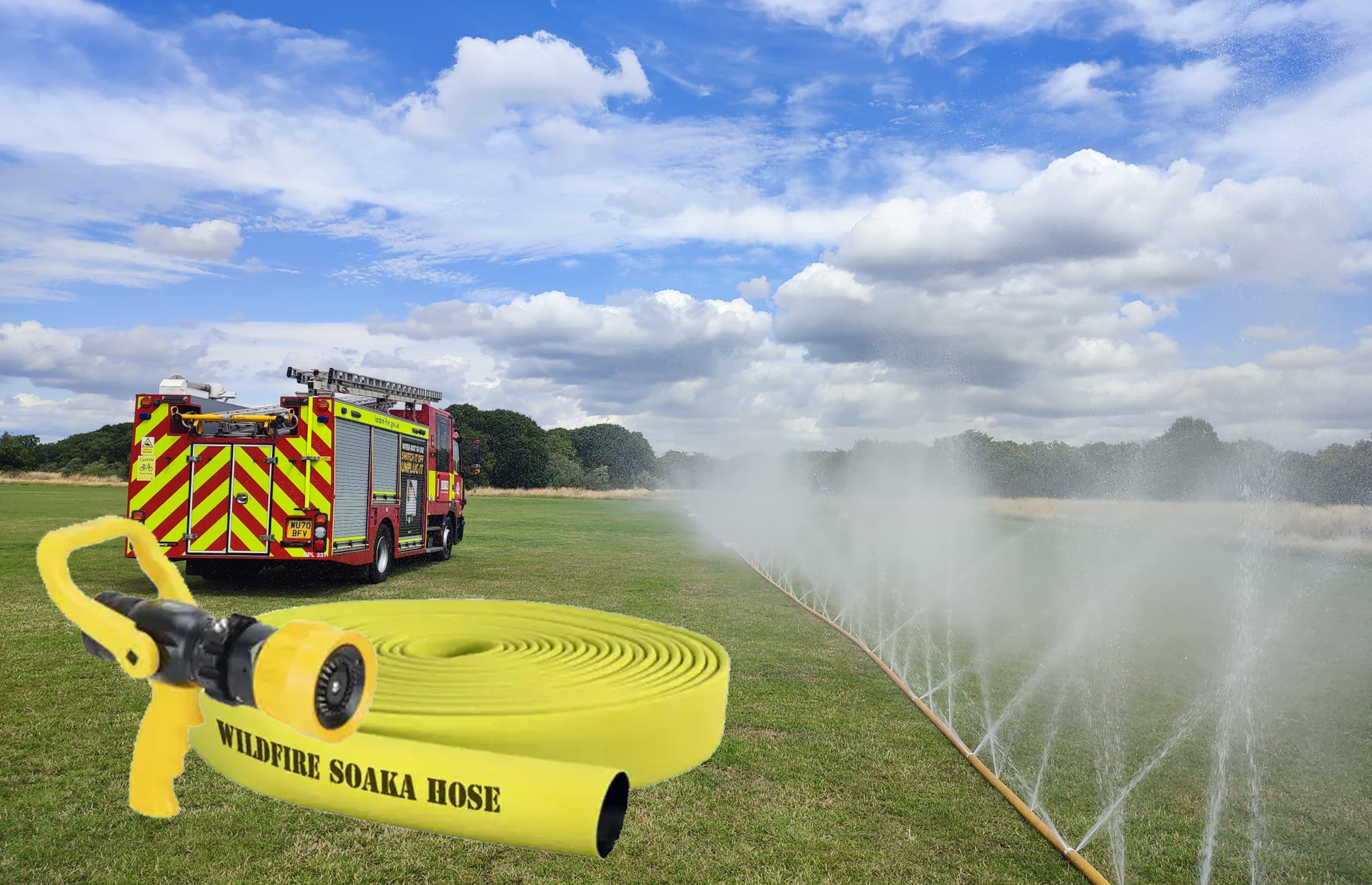
From a distance, most layflat water hoses look much the same. If they’re the right diameter and capable of carrying water at the required pressure, it’s easy to assume they’ll all perform similarly. That’s often where specification mistakes begin.
Wildfire hoses face demands that hoses used for standard water transfer applications may never encounter. The hose may be carried hundreds of metres across uneven ground, repeatedly rolled and unrolled, connected to portable pumps and dragged through vegetation or over rocky terrain, all while crews are trying to establish a reliable water supply as quickly as possible.
Those operating conditions change what matters. Maximum pressure rating is no longer the only priority. Weight, flexibility, handling characteristics, coupling compatibility and pressure loss over long hose runs can all have a greater influence on how well the complete system performs.
At Hoses Direct, we’ve found that looking beyond the catalogue specification often identifies why a hose isn’t performing as expected. In many cases, the issue isn’t product quality at all, it’s that the hose was selected for the wrong operating priorities or the wider system wasn’t considered during specification.
Why Are Wildfire Hoses Different from Standard Water Hoses?
One of the most common questions we’re asked is whether a standard layflat water hose can simply be used for wildfire response. On paper, it often looks possible. The diameter may be the same, the pressure rating may appear suitable, and both hoses are carrying water. The difference lies in everything that happens before, during and after that water starts flowing.
Most industrial or construction water hoses are designed around relatively predictable operating conditions. They may be laid out at the start of a shift, connected to a fixed pump and left in position for hours or even days. Durability and pressure capability are understandably high priorities because the hose spends much of its working life transporting water rather than being handled.
A wildfire hose has a very different job. It may be deployed several times in a single day, carried by hand across difficult terrain, repositioned as the fire develops and recovered quickly once the incident is under control. Instead of remaining stationary, it’s continually being rolled, dragged, connected and disconnected, often under demanding conditions where reliability and speed are equally important.
That changes how the hose should be specified. Weight becomes a critical consideration because crews may need to carry multiple hose lengths over considerable distances before reaching the fire. Flexibility matters because a hose that unrolls easily and follows the ground naturally is quicker to deploy and less likely to kink when routed around trees, rocks or other obstacles. Compact storage also becomes important, allowing more equipment to be carried on
How to Specify the Right Wildfire Hose
The starting point should always be the water supply. A portable pump drawing from an open water source presents different challenges to a vehicle-mounted pump supplied from a hydrant or static tank. Pump performance, available pressure and expected flow all influence the type of hose that will deliver the best results.
Next, consider how far the water needs to travel. Short hose runs across relatively level ground place different demands on the system than several hundred metres routed through woodland or across steep terrain. Longer distances increase friction losses, while changes in elevation reduce the pressure available at the nozzle. These factors may influence the most appropriate hose diameter, even when the required flow remains the same.
It’s equally important to think about how the hose will be handled. Equipment that’s deployed occasionally as part of an emergency reserve doesn’t experience the same level of wear as hose that’s used regularly for vegetation management, training exercises or routine wildfire response. Frequent deployment places greater emphasis on flexibility, ease of handling and the durability of the complete hose assembly.
Before placing an order, it’s worth checking that you can answer the following questions:
- Where will the water be supplied from?
- What pump will be used and what flow is required?
- How long are the typical hose runs?
- Will the hose regularly be deployed over steep or uneven terrain?
- How frequently will it be handled, rolled and transported?
- What level of external abrasion is realistically expected?
- Are the couplings fully compatible with existing equipment?
- Is the current hose being replaced because it has reached the end of its life, or because the original specification wasn’t the best fit?
At Hoses Direct, that’s exactly how we approach wildfire hose specification. By understanding the application first and the product second, we can recommend hose assemblies that are easier to deploy, better suited to the operating environment and more likely to deliver reliable performance over the long term.
Frequently Asked Questions
Can I use a standard layflat hose for wildfire firefighting?
While it may be possible in some situations, a general-purpose layflat hose isn’t usually designed around the priorities of wildfire response. Wildfire hoses are intended to be carried, deployed and recovered repeatedly, often across difficult terrain. A standard water hose may transport water perfectly well but prove heavier, less flexible or more difficult to handle during emergency operations.
What pressure rating should a wildfire hose have?
There isn’t a universal answer because it depends on the pump, hose length, flow rate and nozzle requirements. The aim is to select a hose with a working pressure that comfortably suits the application, rather than assuming the highest available pressure rating will provide the best performance.
Does a larger hose always improve performance?
Not necessarily. A larger diameter reduces friction losses over long hose runs and can deliver higher flow rates, but it also increases the weight of both the hose and the water it contains. The most suitable diameter depends on balancing hydraulic performance with practical handling requirements.
How often should wildfire hoses be inspected?
Hoses should be visually inspected before and after use for cuts, abrasion, crushed sections, damaged couplings and worn seals. Organisations may also include periodic pressure testing as part of their maintenance programme, depending on their operational procedures and inspection schedules.
Can wildfire hoses be repaired?
Minor issues such as damaged seals or some coupling problems can often be repaired, but significant damage to the hose itself should always be assessed carefully. Continuing to use a hose with structural damage increases the risk of failure during operation and should be avoided.
How should wildfire hoses be stored?
Cleaning the hose after use, removing grit and debris, allowing it to dry thoroughly and storing it correctly all help maximise service life. Proper storage also makes the hose easier to deploy the next time it’s needed and reduces unnecessary wear while it’s off the vehicle.
How Hoses Direct Helps Customers Select Wildfire Hoses
Selecting a wildfire hose isn’t simply about finding a product with the right diameter and pressure rating. The best solution depends on how the equipment will be used, what it’s connected to and the conditions it will face throughout its working life.
That’s why conversations with Hoses Direct rarely begin with recommending a particular hose. Instead, our technical team starts by understanding the application. Two organisations may both be looking for a 1-inch or 1½-inch wildfire hose, but one could be supplying water over short distances from a vehicle-mounted pump, while the other is deploying several hundred metres of hose across remote woodland using portable pumping equipment. Although the basic specification appears similar, the demands placed on the hose are very different.
When reviewing an application, we’ll typically consider:
- The available water source and pump performance.
- Required flow rate and operating pressure.
- Typical hose lengths and elevation changes.
- The terrain and expected level of abrasion.
- How frequently the hose will be deployed, recovered and transported.
- Weight and manual handling requirements.
- Compatibility with existing couplings, nozzles and other equipment.
- Any recurring issues with the current hose assembly.
Quite often, customers contact us looking for a more durable hose because the existing one keeps failing. Once we understand how it’s being used, the hose itself isn’t always the problem. It may be repeatedly dragged across loose stone, routed around abrasive edges, connected to incompatible fittings or operating in a system where excessive friction losses are reducing overall performance. Simply replacing it with a heavier hose is unlikely to resolve those underlying issues.
This application-led approach also helps avoid unnecessary expenditure. Rather than recommending the highest specification available, Hoses Direct focuses on supplying equipment that’s appropriate for the operating conditions. That means customers receive a hose assembly designed to perform reliably in service, without paying for features that provide little practical benefit in their application. Contact the expert team today to discuss your requirements and we’ll ensure you get the right hose for the job.
Email: [email protected]
Phone: 0333 6000 501