


Most hydraulic faults don’t start with a dramatic failure.
More often, performance gradually drifts away from where it should be. A machine feels slower than it used to. Cycle times increase. Oil temperatures rise. Lifting capacity drops slightly. Operators know something has changed, but identifying the cause isn’t always straightforward.
That’s the challenge with hydraulic diagnostics. Different faults can produce remarkably similar symptoms.
A worn pump, internal cylinder leakage, a relief valve issue or a restriction elsewhere in the circuit can all leave equipment feeling underpowered. Without reliable pressure readings, fault finding often becomes a process of working through possibilities until the real cause eventually reveals itself.
That’s where hydraulic pressure testing kits prove their value.
Rather than relying solely on symptoms, pressure testing provides a clear picture of how the system is actually performing. It allows engineers to see where pressure is being generated, where losses are occurring and how components behave under load.
The result is usually faster diagnostics, fewer unnecessary repairs and a much clearer route to the root cause of the problem.
The Problem with Guesswork
Hydraulic systems have a habit of pointing people in the wrong direction.
A machine loses lifting performance and attention immediately turns to the pump. Pressure fluctuations appear and the relief valve becomes the prime suspect. Sometimes those assumptions are correct. Quite often they aren’t.
The difficulty is that several different faults can create almost identical operating symptoms.
We’ve seen machines where pumps were replaced only to discover the real issue was internal leakage elsewhere in the circuit. Equally, we’ve seen pressure control problems mistaken for pump wear because the symptoms looked so similar from the operator’s perspective.
This is where diagnostics can become expensive.
Replacing components based on probability rather than evidence takes time, increases costs and doesn’t always solve the original problem. Pressure testing helps remove much of that uncertainty.
By taking readings at key points around the circuit, engineers can quickly establish whether the system is producing the pressures it should be and where performance begins to fall away. It doesn’t instantly identify every fault, but it narrows the search considerably.
What a Hydraulic Pressure Testing Kit Actually Tells You
A pressure testing kit won’t diagnose a hydraulic fault on its own.
What it does provide is the information needed to make informed decisions.
When equipment starts behaving unexpectedly, the first question is usually whether the system is generating the correct pressure. If it isn’t, the next step is understanding where that pressure is being lost. A pressure testing kit helps answer both.
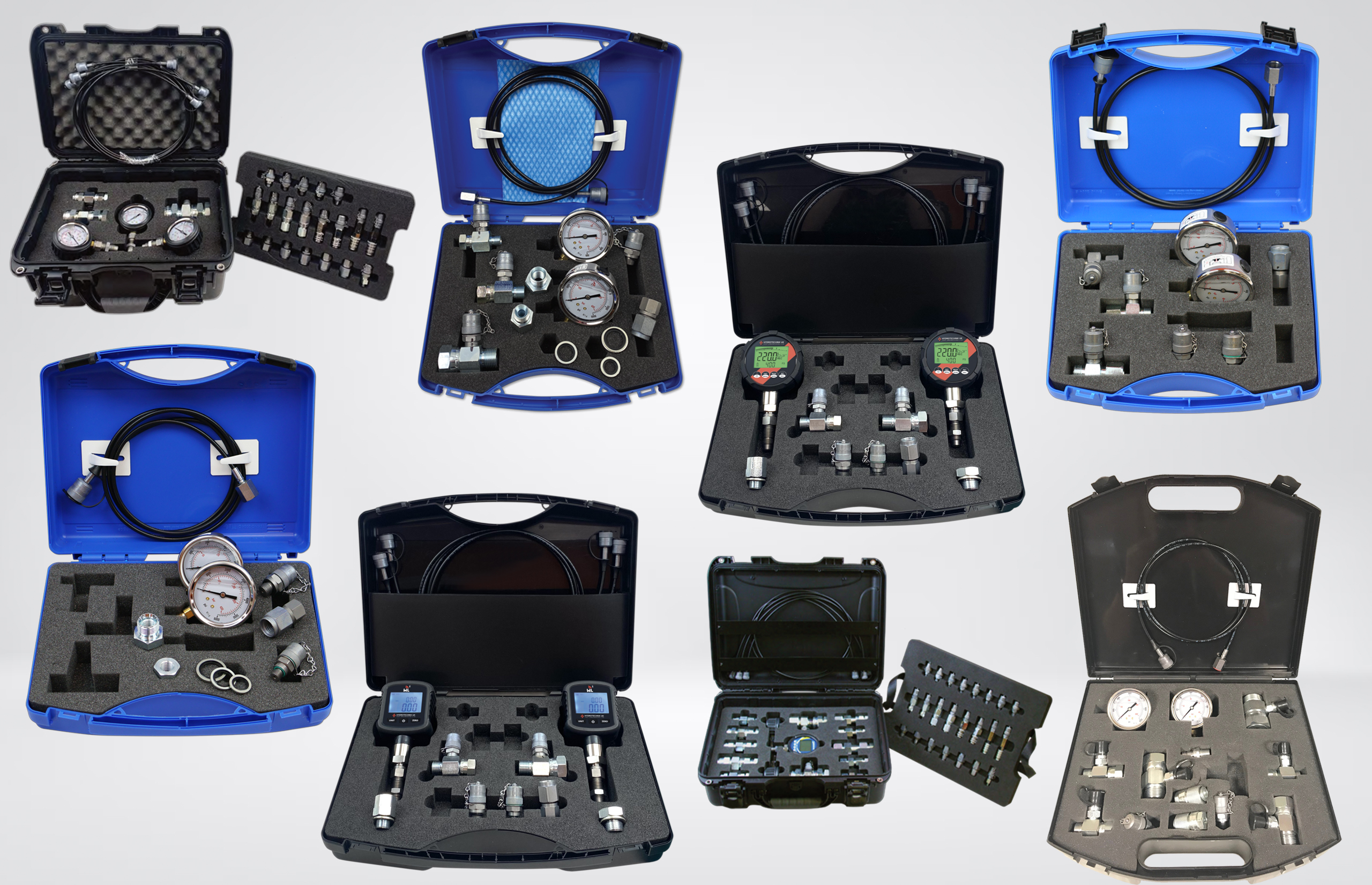
For routine diagnostics, a complete pressure testing kit provides the flexibility to connect to different machines and operating pressures without constantly changing equipment. For more detailed investigations, particularly where small pressure variations need to be monitored accurately, solutions such as the Minimess Pressure Test Kit with Digital Gauge can make diagnostics quicker and easier by providing clear, precise readings.
Ultimately, the goal isn’t simply to collect pressure data. It’s to gather enough reliable information to make the right repair decision before time and money are spent in the wrong place.
Proving a Repair Has Worked
Finding the fault is only part of the job.
Once repairs have been completed, there’s still the question of whether the original problem has actually been resolved. In many cases, the machine may appear to be operating normally again, but that doesn’t always mean the underlying issue has been fully addressed.
This is where pressure testing remains valuable.
By comparing readings before and after a repair, engineers can verify that the system is performing as expected. If pressures have returned to specification, there’s confidence that the repair has been successful. If they haven’t, further investigation can take place before the machine returns to service.
That verification process can prevent a lot of frustration later.
Anyone involved in hydraulic maintenance knows how costly repeat visits can be. Pressure testing provides a straightforward way to confirm that a repair has genuinely solved the problem rather than simply improving the symptoms.
What to Consider When Buying a Hydraulic Pressure Testing Kit
The right pressure testing kit depends largely on the type of equipment you’re maintaining.
For some engineers, a compact kit covering the most common pressure ranges will handle the majority of diagnostic work. Others may need a more comprehensive setup with multiple gauges, hoses and test connections capable of covering a wider variety of machines.
Pressure range is one of the first things to consider. The kit should comfortably cover the operating pressures you’re likely to encounter while still providing readings that are detailed enough for effective fault finding.
Connection options are equally important. A well-stocked kit with a good range of hoses, Minimess test points and adaptors will often prove more useful than a larger kit with limited connectivity.
For general maintenance and fault-finding work,complete hydraulic pressure test kits provide a practical starting point, giving engineers the flexibility to tackle a wide range of diagnostic tasks from a single case.
Where more detailed analysis is required, particularly when monitoring small pressure variations, solutions such as the Minimess Pressure Test Kit with Digital Gauge can provide quick, accurate readings that simplify troubleshooting. Workshop environments may also benefit from systems such as the Metal Box 6 Gauge Panel Minimess Pressure Test Kit, where multiple pressure points need to be monitored and compared during more complex investigations.
The most important consideration isn’t the number of gauges or accessories included. It’s whether the kit provides the information needed to diagnose faults efficiently on the equipment you work with every day.
Contact Hoses Direct for More Information
Hydraulic faults are rarely as straightforward as they first appear.
The same symptoms can often point towards several different causes, which is why accurate diagnostics are so important. Pressure testing removes much of the uncertainty by providing clear information about how the system is actually performing.
Whether you’re investigating a loss of performance, verifying a repair or monitoring equipment as part of a preventative maintenance programme, a quality pressure testing kit can save significant time, reduce unnecessary component replacement and help minimise costly downtime.
For engineers, workshops and maintenance teams looking to improve hydraulic diagnostics, investing in the right pressure testing equipment is often one of the simplest and most effective improvements that can be made.
Speak to one of the expert team today to discuss your current system, and we can work out together what hydraulic pressure testing kit you require to ensure everything is running exactly as it should be.
Email: [email protected]
Phone: 0333 6000 501