


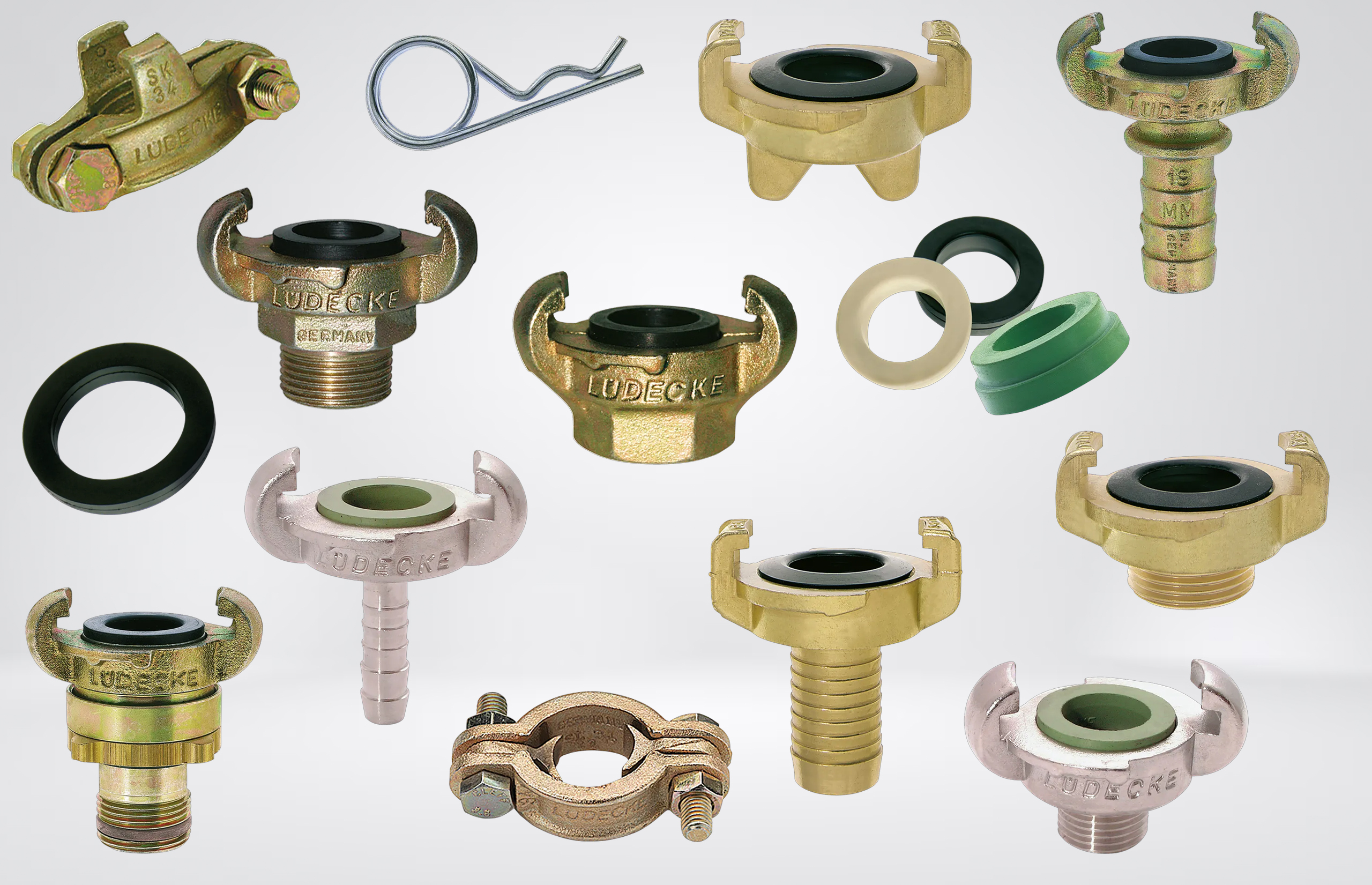
Claw couplings are often used where an industrial hose needs to be connected quickly without introducing an unnecessarily complicated fitting arrangement. Their simple twist-to-connect design makes them practical for workshops, manufacturing facilities, construction equipment and other applications where hoses are regularly installed, moved or replaced.
The Lüdecke range available from Hoses Direct includes open-ended double-lock claw couplings in hose-tail, male-thread and female-thread configurations. This makes it possible to connect hoses directly or adapt a claw coupling connection to threaded pipework and equipment.
These are free-flowing couplings rather than automatic shut-off couplings. Connecting or disconnecting them does not control the supply, so the line must be isolated and fully depressurised using a separate valve before the coupling is opened.
Why Are Claw Couplings Used in Industrial Hose Systems?
A claw coupling connects by bringing two compatible halves together and rotating them until the claws engage. The seal between the two halves is compressed as the connection is made, creating a secure flow path without requiring tools each time the hose is attached.
This is useful in working environments where hose assemblies are frequently connected and removed. A threaded connection could perform the same basic function, but repeatedly undoing threads is slower and can cause unnecessary wear. A claw coupling leaves the threaded or hose-tail side installed while allowing the connection between assemblies to be made quickly.
The relatively open internal path can also make claw couplings suitable for applications where maintaining flow matters. As with any fitting, however, the coupling must be sized alongside the hose and the rest of the system. A larger coupling cannot compensate for an undersized hose, restrictive pipework or insufficient supply capacity.
Lüdecke’s double-lock design provides a more positively retained connection for industrial use. This is particularly relevant where hoses are regularly handled or exposed to vibration and movement. The coupling must still be engaged fully and inspected for damage; the locking design cannot make a worn or incorrectly matched connection safe.
Hose-Tail, Male Thread or Female Thread?
The correct style depends on where the coupling will sit in the system.
A hose-tail claw coupling is used at the end of a flexible hose. The tail size must match the hose’s actual internal diameter, and the hose should be secured using the correct clamp or assembly method. An undersized tail may produce a poor seal, while forcing a hose onto an oversized tail can damage the hose reinforcement or cover.
Hoses Direct offers the steel hose-tail range in sizes from 3/8 inch to 1 inch, including a 3/4-inch safety version. The hose type, pressure and attachment method should be checked together rather than selecting the coupling on bore size alone.
Male and female threaded claw couplings are used where the connection needs to screw into another component. The steel European-execution range includes male and female threaded options from 3/8 inch to 1 inch. Plated female and gunmetal male options are also available within the wider range.
Thread form matters as much as nominal size. A coupling should not be forced into a connection that appears close but does not engage properly. BSP and NPT threads, for example, are not interchangeable even when their stated sizes appear to match.
What Should You Check Before Ordering?
Start by confirming that the existing connection uses the same European claw pattern. Claw couplings can look very similar while using different claw dimensions or standards. If the two halves do not engage smoothly and fully, they should not be forced together.
You will also need to confirm:
- Whether the coupling requires a hose tail, male thread or female thread
- The hose bore or thread size
- The operating pressure and temperature
- The fluid or air passing through the coupling
- The required seal compatibility
- The method used to secure a hose-tail fitting
- Whether the coupling material suits the working environment
The condition of the seal is particularly important. A coupling may still lock together while leaking because its seal has become flattened, damaged or contaminated. Tightening the connection more aggressively will not restore a deteriorated seal and may make the coupling difficult to operate.
The claws and locking surfaces should also be checked for wear, cracking or distortion. Couplings that are frequently dragged across floors or knocked against machinery can suffer mechanical damage that prevents proper engagement. Replacing a seal will not correct damaged claws.
Where the coupling is attached to a hose, inspect the hose immediately behind the fitting as well. Splitting, hardening or movement around the hose tail can indicate that the attachment is failing even if the coupling remains in good condition.
Buy Lüdecke Claw Couplings from Hoses Direct
Hoses Direct supplies Lüdecke double-lock claw couplings for direct hose connections and threaded equipment connections. The range includes steel hose-tail, male-thread and female-thread versions, alongside additional plated and gunmetal options.
Buying through an industrial hose specialist also makes it easier to check the coupling against the complete assembly. Hoses Direct can help customers confirm the correct hose bore, thread, coupling pattern and attachment method rather than treating each component separately.
Browse the Lüdecke claw coupling and industrial hose fitting range, or contact the Hoses Direct technical team if you need help identifying an existing coupling. Clear photographs, dimensions and any visible part numbers will make it much easier to find the correct replacement.
Email: [email protected]
Phone: 0333 6000 501