


Large-bore hose systems need connections that can be assembled quickly, handled in difficult site conditions and separated without rotating several metres of heavy hose. This is where lever lock couplings continue to earn their place.
They are widely used for irrigation, slurry handling, tanker connections, construction dewatering, wastewater and other bulk transfer duties. Their simple lever-operated design allows operators to alter temporary hose routes without loose bolts, specialist tools or threaded connections that become difficult to manage at larger sizes.
Simple operation does not mean specification can be overlooked. Two fittings may look compatible without mating correctly, and the wrong seal, hose or attachment method can make an otherwise suitable coupling unreliable. Pressure surges, abrasive media and unsupported hose loads also cause failures that are sometimes incorrectly blamed on the coupling itself.
Understanding where lever lock couplings work well, and where they do not, is the key to using them reliably.
How does a lever lock coupling work?
A lever lock coupling normally comprises compatible male and female halves with a gasket between their mating surfaces. Once the halves are engaged, closing the lever draws them together and compresses the gasket to form the seal.
Unlike a threaded fitting, neither the hose nor the connected equipment needs to be rotated. That matters when working with long suction hoses, rigid discharge lines or large assemblies that are difficult to manoeuvre once laid out.
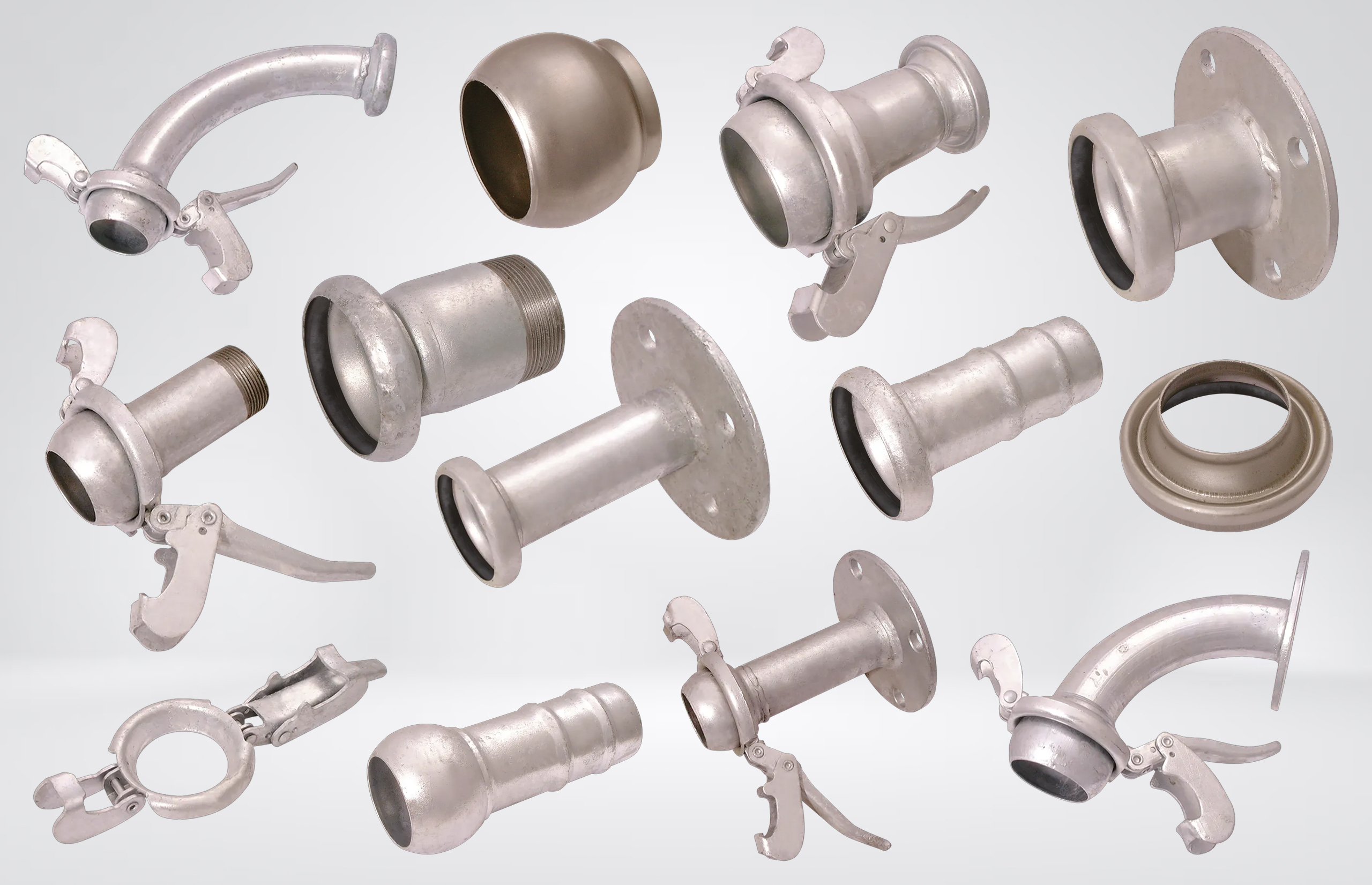
Lever lock systems extend beyond straight hose tails. Depending on the range, components can include:
- Threaded and flanged adaptors
- Elbows and tees
- Reducers
- Blanking caps and plugs
- Pump fittings and strainers
- Replacement seals
This allows hoses, pumps, tankers and fixed pipework to be connected using a common coupling format. Standardising a site around one confirmed system can simplify both installation and spare-parts management.
The terms lever lock, Bauer coupling, Bauer-type coupling and irrigation coupling are often used loosely. They may describe similar connection principles, but they do not guarantee interchangeability. Differences in hook position, mating diameter, sealing face and gasket profile can prevent two nominally identical fittings from forming a secure joint.
If an existing coupling cannot be identified from its markings, its critical dimensions should be checked before a replacement is ordered. A connection that needs excessive force to close, or remains loose once engaged, should not be pressurised.
Why are lever lock couplings still widely used?
The principal advantage is not simply that they connect quickly. It is that they remain practical at bore sizes where conventional threaded connections become increasingly awkward.
A dewatering or irrigation line may be extended, moved between pumps or dismantled for transport several times during a job. Lever operation reduces the time and physical effort involved, particularly when the hose cannot be rotated easily. There are also no flange bolts or separate fasteners to lose in mud, standing water or vegetation.
The mechanism is relatively tolerant of demanding site environments, but it is not immune to poor handling. Soil, fibres, stones and dried product trapped against the gasket will prevent even compression. A lever may still close, yet the joint can begin leaking as soon as the pump reaches pressure.
The range of available adaptors is another reason the system has remained popular. Pumps, tankers, hoses and temporary pipework can be connected without constructing long chains of reducers and threaded adaptors. Fewer unnecessary joints generally mean fewer potential leak points and less restriction through the line.
These strengths are most useful in low- to medium-pressure bulk transfer systems. Lever lock couplings should not be treated as substitutes for high-pressure hydraulic connections or process couplings selected for tightly controlled chemical, hygienic or safety-critical duties.
Where do lever lock couplings perform best?
Lever lock systems are particularly effective where hose lines are temporary, mobile or disconnected regularly. The application still determines the hose, seal and coupling material required.
Agriculture, irrigation and slurry
Agricultural systems often involve long hose runs between pumps, tanks, tankers and field equipment. The ability to add or remove sections without rotating the hose makes lever lock couplings practical for irrigation, dirty-water transfer, slurry and liquid manure.
Slurry requires more attention than clean water. Solids and fibrous material can collect around abrupt restrictions, while high velocity increases abrasive wear through reducers and bends. Maintaining a suitable bore through the coupling system helps protect flow and reduces localised wear, although the pump’s solids-handling capacity must also be considered.
Construction and dewatering
Temporary pump lines used in excavations, quarries, foundations and flood response are regularly moved and exposed to impact, grit and external abrasion. Lever lock couplings suit this working pattern, provided they are cleaned before connection and inspected for distortion.
Routing is often as important as the coupling choice. A filled hose is heavy, and allowing that weight to hang from the pump outlet can side-load the joint. Supporting the hose and avoiding a tight bend immediately behind the tail will improve reliability and protect both the fitting and hose reinforcement.
Wastewater and sludge
Wastewater is not a single predictable medium. It may contain abrasive solids, fibres, oils, treatment chemicals or cleaning residues. These affect the hose lining and gasket differently, so specifying the system simply for “wastewater” can leave important compatibility questions unanswered.
The solids size, temperature, chemical content and cleaning process should be established. The system also needs a safe method of draining and cleaning retained product before disconnection.
Industrial water transfer
Lever lock couplings can be used for washdown water, tank filling, temporary cooling circuits and other general industrial duties. However, treated process water may contain biocides, inhibitors or cleaning chemicals that alter the material requirement.
A coupling used successfully for cold clean water should not automatically be transferred to a heated or chemically treated circuit without checking its body, seal and hose compatibility.
Specifying a complete lever lock assembly with Hoses Direct
Hoses Direct supplies lever lock couplings alongside the hoses and attachment components needed to build a complete transfer assembly. Depending on the application and available range, this may include hose-tail couplings, threaded and flanged adaptors, bends, reducers, blanking components, replacement seals and suitable suction or discharge hose.
Obtaining these components as a matched system reduces the risk of mixing coupling profiles, selecting an incompatible gasket or attaching the fitting to unsuitable hose. It also gives buyers one point of reference for the pressure, media and connection requirements across the assembly.
Hoses Direct supports fluid transfer applications across agriculture, construction, dewatering, wastewater, utilities and general industry. Where an existing component is uncertain, the technical team can help assess its markings, measurements and application before recommending a replacement.
Lever lock couplings remain popular because they perform a specific job very effectively: connecting large-bore transfer hoses quickly in systems that need to be moved, altered or dismantled. Their simplicity is a strength, but only when pressure, material compatibility, hose selection and installation are treated as part of the same specification.
If you need help selecting a coupling or complete hose assembly, contact the expert team at Hoses Direct with the fluid, temperature, pressure, hose bore, pump details and existing connection type and we will recommend the best solution for your application.
Email: [email protected]
Phone: 0333 6000 501